


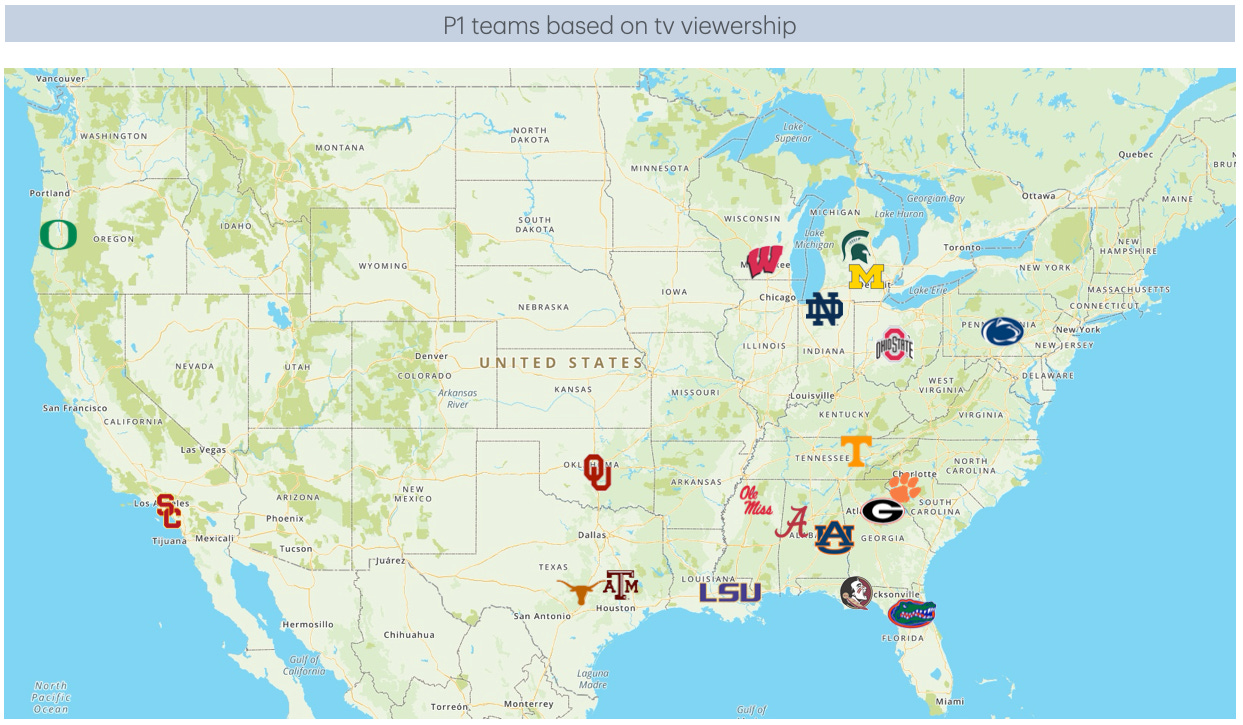
The threads below had me curious, so I mocked up a P1
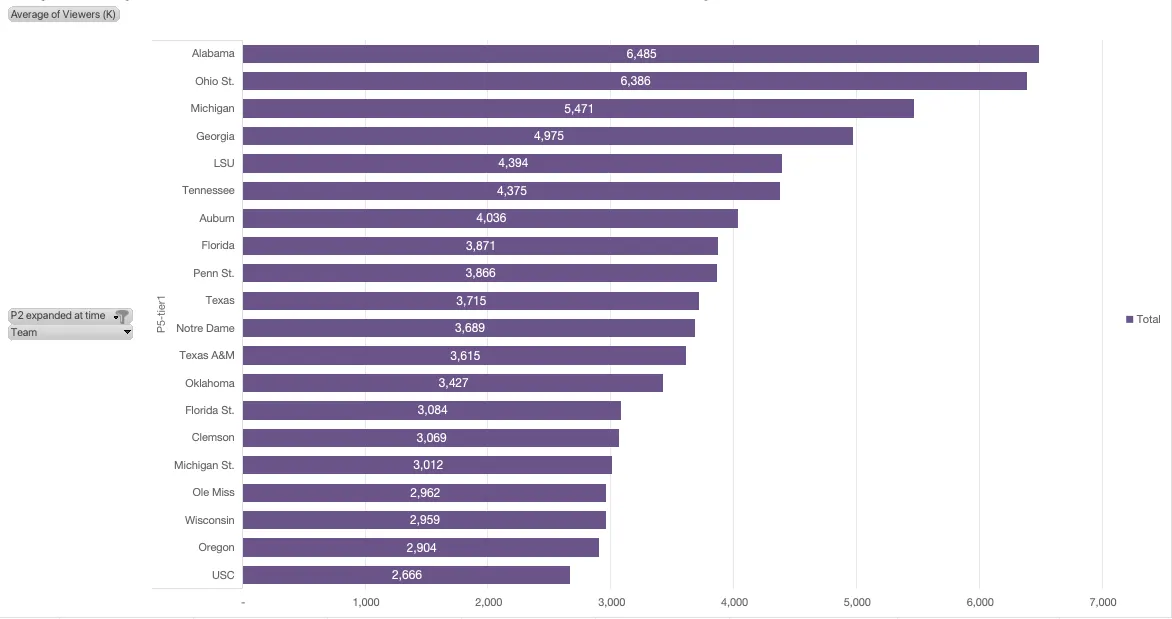
I used my tv viewership data to segment out the teams that earned a spot in the P1 based on their regular season averages. And I carried it forward to see how that might influence an expanded playoff.
As always, happy to discuss.
** Edited by HokieAl at 4/28/2026, 12:18:21 AM
13 Replies
S
Stech
3mo
they just announced the 76 NCAA basketball tournament. Also, it seems like the 24 CFB playoff is getting closer with the B1G starting to let go of getting several automatic bids to make it happen.
(In response to this post by HokieAl)
3mo
From a logical view to avoid risk of a large investment failing, the lack of inclusion for over 2/3 of the country should be a huge concern.
Personally, I think the P1 would need at least 25 states, which means they would need 25-30 teams.
As for the playoff, I’m guessing that 24 will definitely happen. They are just negotiating the details now and carving out their chunk of the money and territory and control.
** Edited by HokieAl at 4/29/2026, 11:36:13 AM
(In response to this post by Stech)

3mo
is streaming more than the previous generations, it would be interesting to see if the assumption people are making about the location of the schools' fan base is as accurate as people think. It may be an outdated model if the schools have enough of their fan base located in all 50 states to the point it may be accurate to say they have a "national fan base." That doesn't factor in the gambling aspect into the equation.
(In response to this post by HokieAl)
3mo
I look at it more as how many fans of other schools feel left out?
Every very state has people that are fans of local schools even if they didn’t attend, plus actual school alumni. If you exclude highly populated states like AZ, VA, NY etc, will those school and casual fans keep caring and watching?
The media companies bought themselves 2-3 years where they can say that viewership numbers are higher because the changed how it is measured. The new way is an artificial inflation of viewership compared to past years because they use more data now. But they won’t be able to hide the numbers after a couple more years. And in two more years we will be able to see if there is a true trend up or down for viewership.
(In response to this post by VTHokie2000)
3mo
Since all/just about all gambling organizations have a mobile app to make it "easier" for people to gamble, they may still feel "engaged" if their team/school is not apart of the group (aka P2 conferences or Super League). It is even possible that there is no connection between gambling activity and viewership. If I decide to place a parlay bet involving 6 games occurring at the same time, then it is likely I will end up only watch 1 game or maybe flipping between 2-3 of the games. If the network(s) broadcasting the games I didn't watch have a business relationship with the gambling app I used to place the bet, then the network still "wins" even if it isn't reflected in the ratings. Granted this information is not available to public, so I do get why discussions are focused only on data points that the public can access. However, it doesn't mean that the gambling data isn't relevant too since the networks and maybe the schools have access to it.
(In response to this post by HokieAl)
3mo
remain apart of the NCAA DI as it stands now or do its own thing. A potential sub-debate within that debate is whether the P1 exists for specific sports or for all sports. The reason I find that fascinating is because how those scenarios play out could determine what action (if any) Congress could take in the future. For example, if the P1s decide to do their own thing for all sports including scheduling games only among themselves, holding a "draft" of some kind for all sports to control how transfers from other schools become apart of the group, etc., then the P1s may have done enough of the leg work to make it easier for Congress to amend the Sports Broadcasting Act of 1961 to include them in the antitrust exemption while excluding the remaining colleges (NCAA, NAIA, JUCO, etc.) from the exemption.
If the P1s still want to participate in the NCAA DI (as we know it today), then it may be too messy for Congress to even consider amending the Act. At least Congress may not be interested in giving the exemption to all schools because it would open the door for things to go back to the way they were before SCOTUS ruled in 1983/4 that the NCAA violated antitrust laws with the broadcasting of games. Plus, it may even open the door to where the NCAA (all 3 division levels), NAIA (all 2 division levels), and JUCOs may have to agree as a whole to negotiate future media contracts for the entire collective. At least it may not be able to broken into subparts where the schools who want to pool their resources can do it and the schools that don't can opt out regardless of their association affiliation and/or even division level. Even if the collectives can be broken down to division levels, you can bet there will be some P1 schools who won't want to get in bed with the lesser valued DI schools because they enjoy the status quo too much (think the differences in the value of the conference network contracts).
(In response to this post by HokieAl)
3mo
Which means that a P1 scenario is entirely possible because the P1 schools could leave the SEC/BIG with no penalties. They would only need three things in place to make it happen.
1. Media partner(s) with contracts and money ready for regular season games
2. Playoff control to enable them to monopolize bids (assuming they stayed within NCAA D1)
3. Agreement to all make the move at the same time (based on contracts, likely between 2030 and 2034)
The best path for making this all happen is for it to be football only IMHO.
(In response to this post by VTHokie2000)
S
Stech
3mo
is a problem right now with Michigan and USC not wanting to sign one through 2036, which the PE Company wants for their Billons of dollars.
(In response to this post by HokieAl)

3mo
looking to extend it until 2046.
"The deal would call for an extension of the league's Grant of Rights through 2046, providing long-term stability and making further expansion and any chance Big Ten schools leave for the formation of a so-called "Super League" unlikely."
Link:
Clkick Here
(In response to this post by wwhokie1)
3mo
My very basic take is that a GOR is fundamentally tied to the media contracts. So for the ACC, our GOR/media contract goes to 2036. For the BIG, their current media contract goes to 2030.
Where it gets tricky is that some GORs have other very strict conditions in place (e.g., the ACC forcing schools to give up all rights even if they leave the conference). But not every GOR has this. And the BIG has been very secretive so none of us knows what is actually in the BIG GOR for commitments. All we do know is that it ends in 2030, which is the current media contract.
The link you shared, along with many other links from a google search, points to the private equity proposal and is not finalized. So the one thing we do know is that the BIG GOR goes to 2030. And that would be the window for teams to jump to the P1 if they wanted. Especially since the SEC doesn't have a GOR (just a contract that runs to 2034).
(In response to this post by VTHokie2000)
3mo
finalized yet. Even though the article implies the extension would mean the "Super League" is off the table, I am not sure that is necessarily true. The Super League could still exist if the Big Ten and SEC were willing to work together. Instead of being 2 independent conferences, 1 would essentially become the "AFC" and the other would essentially become the "NFC." Why I noted in another post that the Super League may want to incorporate the 2 brands to give the league a head start in marketing. Hence why I am not sold either way on whether the schools would want the Super League to apply to just specific sports or to all sports.
A risk to limiting it to just football and let's say basketball is the impact it could have on all the other sports sponsored at the NCAA DI level. I'm not talking about the financial impact, but the working relationship between the Super League schools and the rest the NCAA schools (not just DI schools). If the tension is allowed to fester over time, then eventually there will come a point where the Super League schools will be forced to do it for all sports because the working relationship has gone from a healthy one to a more toxic one. Now the fans may never see any of it because it is kept behind closed doors when the various committee members meet throughout the year. However, things may slowly leak out to the public where people start to form the impression "that something ain't right" among the members even if they can't put a finger to the cause. There may even be some of that going on now after the P2s performed their hostile takeover of the FBS Playoffs.
(In response to this post by HokieAl)
3mo
moment. If the P1 scenario does come to fruition, then it would not surprise me if the Big Ten and SEC are somehow involved in the discussions so they can remain in tact. The structure wouldn't really be any different than the NFL (AFC vs. NFC), NBA (East vs. West), or MLB (AL vs. NL) structure. Plus, from a marketing standpoint the P1 "league" could use the Big Ten's and SEC's brands as the foundation for their marketing plan. No reason to reinvent the wheel if you can BASF something. Plus, if they want antitrust exemption, then they could have a "national contract" with both Fox and ESPN just like the NFL has multiple "national contracts" now. If they don't want to pursue the exemption, then they could turn the BTN and SECN into "regional networks" just like what you currently see with MLB, NBA, and NHL who don't have antitrust exemption.
A reason the NFL wanted the exemption is because they play so few games including the playoffs, that regional contracts would cut into their profit margin. At least that is a plausible explanation as to why the NFL is the only major pro league to take advantage of the law. If the NFL played a lot more games, then we should see each team with their own regional network deals and an end to the NFL needing the exemption. If the NFL no longer needed the exemption, then it should mean the NFL could now directly compete against HS regular games on Fridays and college regular games on Saturday.
Since the P2s now "control" the FBS Playoffs, there may not be any financial incentive to pursue a P1 scenario. Even if the P1 scenario applied only to football. You might even say once the P1 comes into existence, then the schools would lose any leverage they have now when negotiating with the rest of the DI schools or FBS schools. Particularly since P2s resorted to using a hostile takeover tactic to wrestle control of the FBS Playoffs and non-profit organization that "runs" it away from the rest of the FBS schools and Notre Dame. Basically they said if the schools didn't agree to the demand, then they were going to leave the non-profit and take "all the nice things" with them.
(In response to this post by HokieAl)