

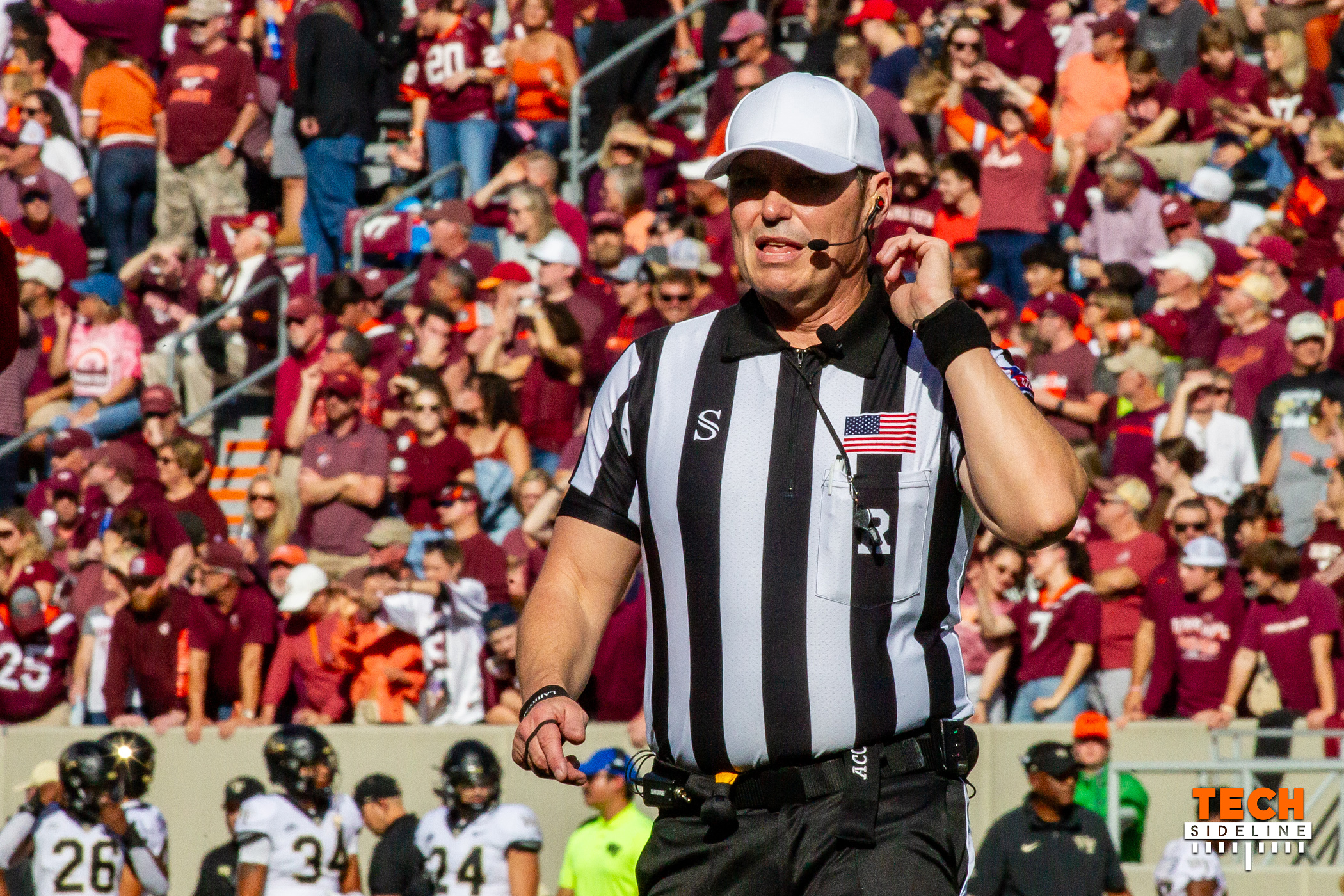
With the bye week behind us, and a short week ahead, I figured it’d be a good time to break down a few interesting scenarios from around the ACC so far this season, plus some bonus clock shenanigans from the B1G.
I’ll cover the You Make the Call from the Stanford game (go vote on that one if you haven’t already) in the upcoming week, following the BC game. For now, let’s take a look across the conference and see how things have shaped up for Tech’s all-coast conference foes.
We all know targeting is completely subjective and used to control the game (TIC)...but if you get a chance, look at the call vs Cal in the game last night. The DB literally tried to avoid the hit, the SDST receiver ended up leaning forward with his head causing the head/shoulder contact with the DB. - RRHokie90
What better time to review a targeting call than right after a similar replay-initiated call had such a big impact on a Cal game? If there are any Cal fans/sympathizers reading, my apologies for rubbing salt on the helmet-contact wound here.
Still, was it enough to warrant an ejection, and how did that differ from the infamous call against Miami?
First, while the Miami call I covered earlier in the week involved contact with the crown of the helmet, this one is back to what I’ll call “traditional” targeting: forcible contact to the head/neck area of a defenseless player. First, the receiver making the catch is absolutely defenseless by both the letter and spirit of the rule, so that box is certainly checked.
Next, we need to see forcible contact from the defender with his “helmet, forearm, hand, fist, elbow, or shoulder.” Worth noting, I’m pretty sure the hand/fist/elbow bits of the rule are more geared towards protecting passers in the pocket, and I don’t exactly envision any DBs back-handing a receiver in the head coming over the middle. Anyways.
We can clearly see contact with the defender’s shoulder, so that’s another box indisputably checked. All that’s left is an indicator of targeting, and the one that I see lining up perfectly is the third one listed by rule:
Leading with helmet, shoulder, forearm, fist, hand or elbow to attack with forcible contact at the head or neck area. (9-1-4 Note1)
So not only does the defender have to make contact with his shoulder, he must lead with that shoulder in order for this indicator to be present. Again, I think there’s little question that with the little dip right before contact, the Cal DB has put himself squarely into this category.
So by rule, this is a clear targeting call, and I think the officials absolutely got this one right. Which brings me to RRHokie90’s final point: the SDSU receiver “leaning in” or changing the proverbial strike zone.
I see this a lot, and I understand the frustration (particularly when it’s a Hokie on the business end of the ejection decision): the game moves fast, and last-second moves from an offensive player can take what was about to be a legal hit and turn it into a 15-yarder and a one-way trip to the locker room.
This to me highlights what I view as the NCAA’s goal with this rule: it’s on the player initiating the contact to do everything in his power to ensure that contact is legal. That includes accounting for ways that the receiver/runner’s body may fall in the split-second before the collision.
I’ve covered a couple of plays so far this year where a defender was bailed out of a costly penalty simply because the player they hit happened to turn, or fall a certain way just before/after that contact. It’s part of the game. In this case, had the receiver stayed upright, that’s more than likely a solid “separate the man from the ball” type of play.
But the receiver didn’t stay upright, and as a result, the DB was ejected. I view that as perfectly in line with the objectives of the rule, and I’m comfortable putting the onus on the defender to make more of an effort to ensure he delivers legal contact.
What about the horse collar tackle flag on F$U? That looked less abrupt than the one that wasn’t flagged on Drones last week. - bushartbs525
The irony here is that the flag was actually picked up, and (at least per R over the PA system) was initially for a facemask foul.
As for R… beg your pardon?
My only guess is that R viewed the defender’s grab as occurring at the shoulder, rather than the facemask, and therefore overruled U. In theory, that’s exactly how it should be done - R had a better angle on that exact sequence, after all. But in this case, that looks like a pretty clear grasp of the right edge of the facemask to me, so I’d have a really hard time overturning my U if I was in R’s position.
Now what about what appears to be a clear horse collar tackle?
This one is certainly closer to a foul than the one I covered against Drones, in my opinion, simply because the ball carrier goes down while the back of his jersey is being pulled. That said, I actually understand the no-call here.
Simply put, I don’t view the grasp of the jersey to be the primary force bringing down the Clemson QB. Most of the jersey pull occurs after the QB is already on the ground; I can understand the judgment that it looks worse than it is simply because of how hard the jersey is pulled as the QB rolls over.
Plus, there is another defender driving him to the ground, which I would say probably supplies most of the force to bring him down. Importantly - just like with Drones - the QB is not in extreme danger of the cringe-inducing, bent-backwards tackle which inspired the rule in the first place. That to me is enough to land this one just on the side of “legal tackle.”
That said, I’d very much be in favor of a rule change, tightening up that interpretation of “abrupt,” and perhaps indicating that any force from the back of the jersey which contributes to a ball carrier going down constitutes a foul. After all, the idea is to change defenders’ behavior and eliminate the risk of those leg-snappy horse collars as much as possible.
I just don’t see the logic in giving defenders a pass on such a risky move simply because the player they’re tackling happened to fall in a certain direction. Until such a time as that rule is changed, though, it’s at least informative to see how this rule has been applied in consecutive weeks in the ACC. So long as it’s consistently called this way - not punishing defenders when the ball carrier is not in substantial danger - I think I can live with it for the rest of the season.
On Miami’s game winning TD, RG #73 is clearly illegally downfield, no? - HokiePride
Is it really an ACC football season without a controversial score involving ineligibles downfield? Happily for anyone financially incentivized to cover college football officiating, the answer so far appears to be, “no.”
At that point, an offensive lineman could have easily made it a step or two further downfield, making the potential infraction look much worse than it actually was. Such was the case in that UNC game, where the play, as far as I could tell from the camera angles supplied, did in fact appear to be legal.
No originally ineligible receiver shall be or have been more than three yards beyond the neutral zone until a passer throws a legal forward pass that crosses the neutral zone. A player is in violation of this rule if any part of their body is beyond the three-yard limit. (7-3-10)