

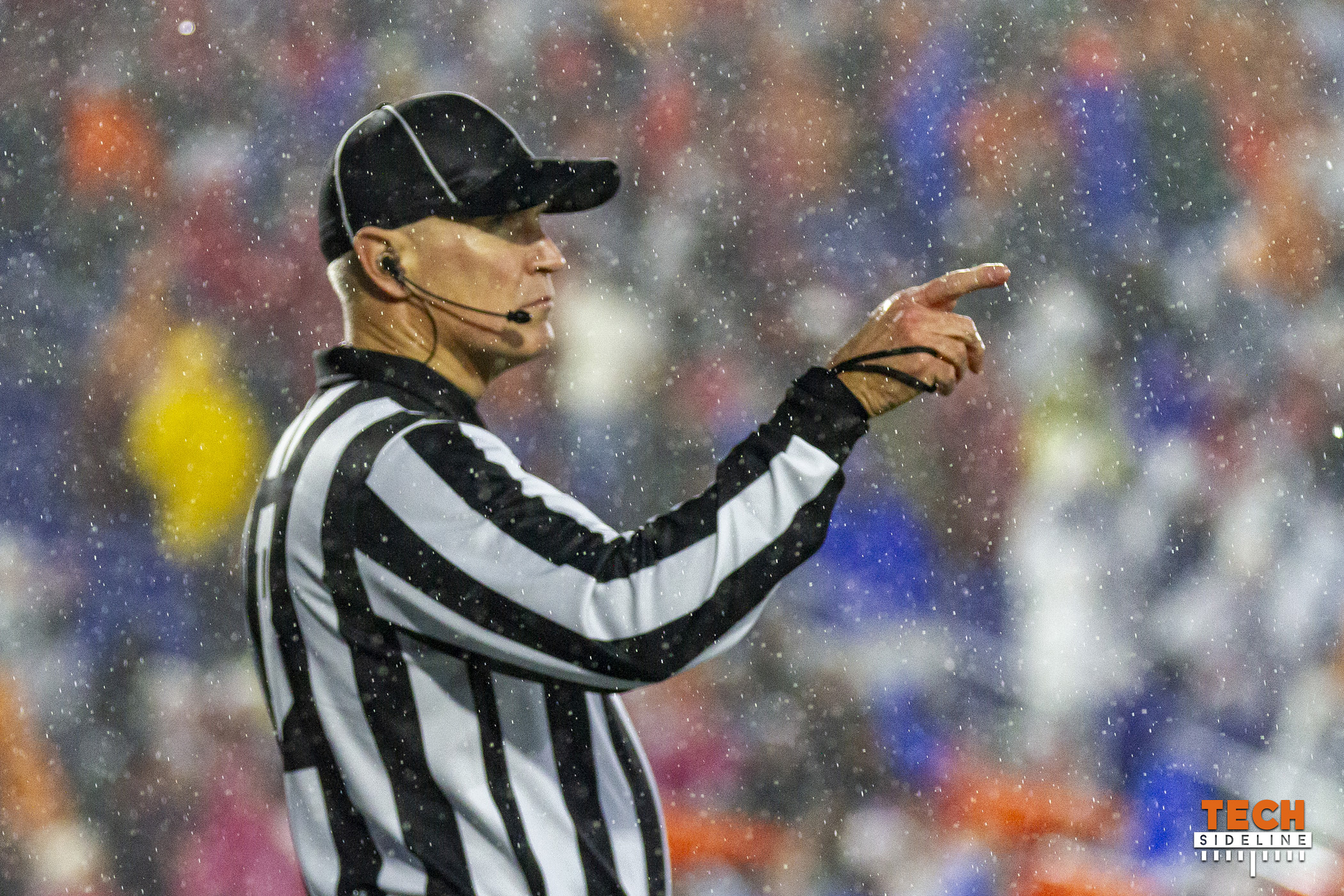
I don’t think I could sum up the Hokies’ bowl experience any better than Chris did in his Thursday Momentum and Confidence article: “Well, that was fun.”
Still, the Military Bowl fun doesn’t have to end now that the game is over. All season long, I have covered holding - from the very first in-season Ask a Back Judge where I went into detail about the officiating philosophies of holding, to a sprinkling of play breakdowns throughout the year.
In each article, there was a healthy discussion of what was actually a hold, and there was far from universal agreement with my take on most plays. Well, my delightful reader, now it’s your turn to make the call.
I’ve got two plays for you from the 4th quarter of the Military Bowl where Tech was driving to put the final nail in the Green Wave’s coffin. In each play, I’ve highlighted a player that has executed a potentially questionable block, and Chris will be kind enough to include a poll following each clip (thanks, Chris!).
The question for you is simple: foul or no foul? If you’re the covering official, are you reaching for that rain-soaked flag here, or letting the play stand?
I’ll come back to these plays in the next week or so (I’ve already jotted down some of my own thoughts) and see how closely we (and all of you) agree. If you want to go back and take a look at my main holding article, you can check that out here.
Remember that the three keys we consider are: 1) A material restriction, 2) It occurs at the point of attack, and 3) It had an effect on the play (the defender couldn’t go where he wanted to go).
With that, make the call:
Running Into the Kicker: Forcible Contact or A+ Acting?
For the final full-play review of 2023, let’s take a look at that running-into-the-kicker call that threatened to almost make the game’s ending somewhat competitive.
The running into the kicker/punter call. It didn’t matter in the long run, but it ticked off my son. Both the call & the fact our guys even got close to the punter at that point. Punting at that point meant the Tulane coach was showing the white flag. It seemed the punter initiated the contact. - RRHokie
The Play: 4th and 8 from the Tulane 44-yard line, the Green Wave lines up to punt. Punter Will Karoll (#49) gets the kick away, but is evidently contacted late by Keyshawn Burgos (#2). Tucker Holloway (#11) fields the punt cleanly (an impressive feat in the driving rain), but it looks like that effort is wasted.
The Rule: Roughing or Running Into Kicker or Holder 9-1-16
a. When it is obvious that a scrimmage kick will be made, no opponent shall run into or rough the kicker or the holder of a place kick…
- Roughing is a live-ball personal foul that endangers the kicker or holder.
- Running into the kicker or holder is a live-ball foul that occurs when the kicker or holder is displaced from their kicking or holding position but is not roughed.
- Incidental contact with a kicker or holder is not a foul.
b. A kicker or holder simulating being roughed or run into by a defensive player commits an unsportsmanlike act
The Officiating Standards section of the rule book also gives a helpful guide for distinguishing between roughing and running into the kicker:
It shall always be roughing the kicker when there is forcible contact to the plant leg, whether or not that leg is on the ground. It shall be running into the kicker if a defender simply “runs through” the kicking leg and there is no forcible contact. All other contact shall be based on the severity and the potential for injury to the kicker.
The Call: Running into the kicker, 5-yard penalty, replay 4th down - 4th and 3.
The Breakdown: R and C are off the screen, as they are at an appropriate depth. This does two things: first, it enables them to have a wide enough field of view to catch all the relevant action, even if the punter rolls out before kicking the ball (or executes a fake) or the snapper air-mails the long snap, without having to move much initially. Second, it makes it really difficult for a nitpicky nerd like me to judge their mechanics.
I bring that up because I’m wondering how good of an angle they each had on the punter’s lower (R) and upper (C) body. Being either too head-on or too wide can give a wonky view of things, especially if the rain is coming down hard enough to hamper visibility - certainly a valid concern at that point in the game.
First thing we’re looking for: contact to the plant leg (Karoll’s left leg) - that draws a 15-yarder every time, no questions asked. Happily, we’re clearly a-okay on this one.
Next, we want to look for contact to the kicking leg. Ironically, this is where we see kickers get spun around like a top, only for a 5-yard “running into” flag to follow. You better believe that’s a fun one to explain to a coach, but it’s generally the correct call. In this case, I can actually see Karoll’s right foot peeking out between his and Burgos’s torsos.
Finally, is the kicker displaced? This can be anything from being knocked to the ground to being moved laterally off the spot he would have landed under his own power. Karoll hits the ground, so the question becomes to what extent Burgos was responsible for the contact.
The Verdict: I think the call was marginal, bordering on incorrect, and credit to Karoll, he did exactly what he’s been coached to do: hit the ground (and in a reasonably believable fashion, no less) at the slightest hint of contact.
I say I’m skeptical of R’s and C’s positioning here because R should be able to clearly see Karoll’s kicking leg swing freely - Burgos isn’t running into/through that knee or ankle to spin him to the ground. C, on the other hand, should be able to see Karoll’s right arm and be able to judge whether it’s him or Burgos who initiates the contact that drops the punter to the ground.
There’s an argument to be made that Karoll is the one who hooks Burgos’s arm, and then uses that to bring himself down as Burgos runs by. At the very least, this is the absolute definition of incidental contact, in my judgment - the kick is away, the punter has returned to the ground, both his kicking and plant legs are clear of the defender, and there is no substantial risk of injury. As a general rule, if I can’t tell who initiated contact (be it for a hold, pass interference, late hit, etc.), I have a hard time penalizing one player for that contact.
I’m guessing that whoever threw the flag (R or C, the camera doesn’t catch it) saw the jerky way that Karoll fell over after he and Burgos locked arms, and that’s what was called. I’d still consider it a decent bit of acting on Karoll’s part.
I included part b of the roughing/running into the kicker rule above to highlight a point: the rule exists in the rule book (and has for a while), and there have absolutely been instances when it should have been called against a punter, but I don’t think I’ve ever seen an unsportsmanlike conduct foul called there, not even once.
The Approved Rulings section even accounts for a kicker that is run into, but simulates being roughed (I presume by grasping at an uncontacted limb, for example): offsetting fouls. It’s supposed to be a foul that’s callable.
On this play, I can see how R would give the benefit of the doubt to the punter, particularly with the game already essentially decided - there’s no reason to pile on with a 15-yard UNS. Still, there are plenty of times when I wish a white hat would not be a coward, and throw the flag on the punter that is so clearly flopping. In this case, I think ruling “incidental contact” and therefore no foul would have been the appropriate action.
Game Control and Preventive Officiating
To wrap up 2023, I want to highlight some excellent late-game dead-ball work by this Sun Belt crew.
Even if we end up throwing a flag or two at the end of a scuffle, it’s going to take a lot longer to settle everyone down than if we had gotten everyone to their respective huddles/sidelines before anything got too heated.
In this case, it’s the 4th quarter, one side is clearly frustrated with the scoreboard, and the other side is perfectly content to offer not-so-subtle reminders of said scoreboard. This is where things can get pretty ugly.
One of the best non-flag methods we officials have of defusing situations is simply our presence. It’s critical that we “show our stripes” quickly at the first sign of trouble, and that’s exactly what U does here. L is also well off the sideline and in the thick of things, and FJ even comes in to offer support from his deep position.
This is all really good dead-ball officiating, keeping things from getting out of hand. Everyone gets back to their side of the line of scrimmage, and we’re ready to keep playing football.
If I was to nitpick, I’d say LJ can do a better job not turning his back on the players, and supporting his U to make sure nothing gets crazy in the middle. I’ve been in his spot more times than I can count: trying to make sure all my dead-ball duties, such as ball rotation in a wet game, are accounted for and the game can continue smoothly. It’s a lot to handle, but keeping tabs on the players has to come first.
Next, as much as I can appreciate the U’s firm response here (so help any player that gets on the wrong side of him - anyone willing to stand their ground in the middle like that is not to be messed with), I’d probably tell him not to grab a player like that. Generally, officials should do everything we can to minimize physical contact with players - there’s just way too much that can go wrong (or be perceived to go wrong).
Still, I think U’s reaction here is appropriate overall. He knows which side (Virginia Tech) has the upper hand, and he’s letting them know that he expects them to focus on finishing the football game and not on rubbing the opponent’s face in it. In this case, giving the losing side a bit of room to express their frustrations is perfectly fine and understandable - they’re college kids, not robots - so long as they’re not looking to start a physical altercation. Well done by this crew to ensure the game finished in a mundane fashion with nobody ending up on the business end of an internet meme or SportsCenter segment.