

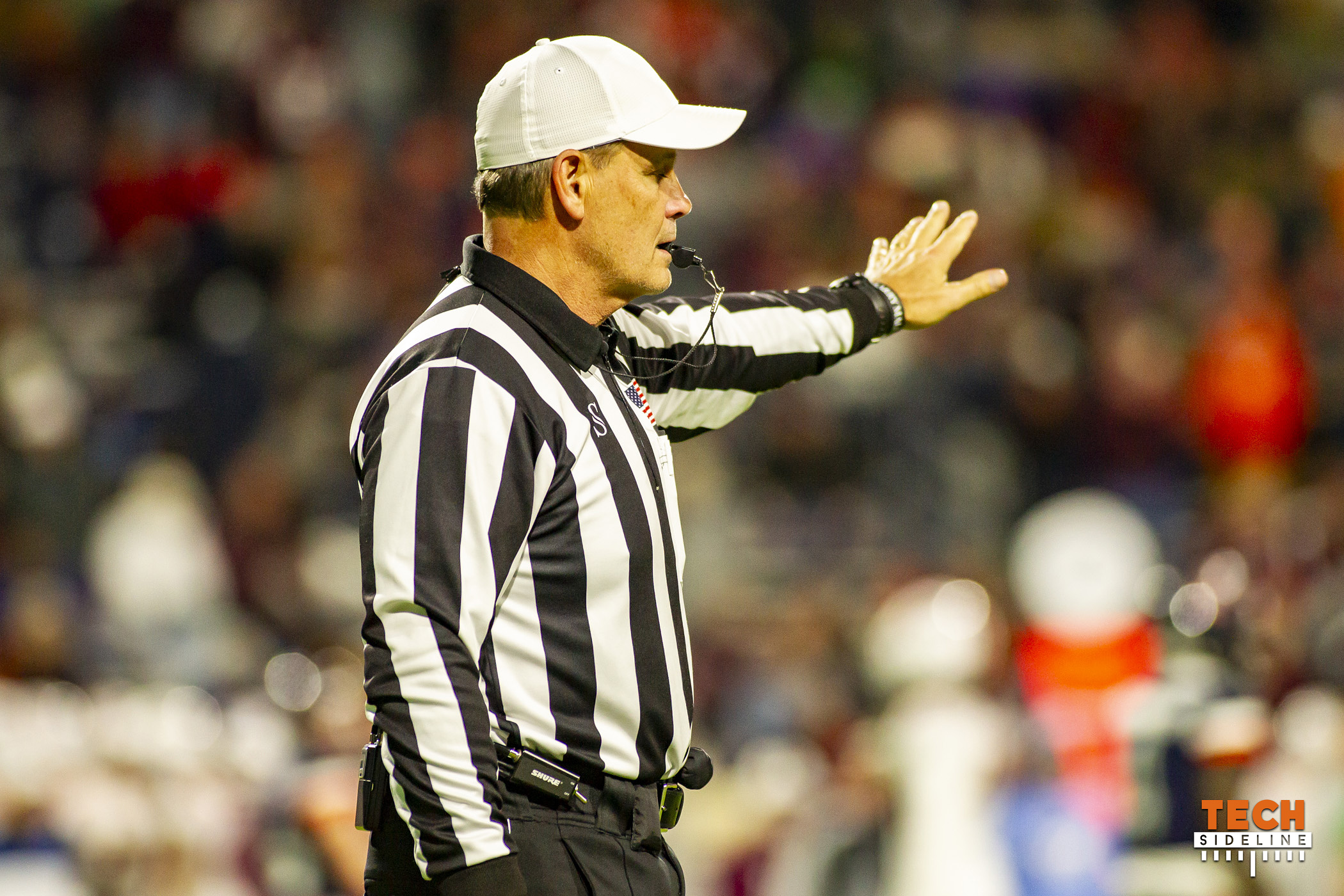
I’m not sure what was more satisfying this weekend: watching Tech boat race the Hoos on their own field, or housing an entire pumpkin pie on my couch while doing so. And I love me some pumpkin pie.
While the officials clearly weren’t going to decide the outcome of this in-state contest, there were still enough controversial calls to make it interesting. If you’re new to the series, be sure to check out my fundamentals article for a primer on how we officials approach the game, and the keys and responsibilities of each official’s position.
Let’s start with a hold - yes, that hold.
https://twitter.com/ChrisColemanTSL/status/1728522107796046043?ref_src=twsrc%5Etfw%7Ctwcamp%5Etweetembed%7Ctwterm%5E1728522107796046043%7Ctwgr%5E8c68cde0903f2bf1d71d7df77eda9a97816ecd76%7Ctwcon%5Es1_c10&ref_url=https%3A%2F%2Fvirginiatech.sportswar.com%2Fsubscription%2F2023%2F11%2F28%2Fask-a-back-judge-holding-and-roughing-the-passer%2F
It was quite obvious I wasn’t going to have much of a choice on this week’s play selection, and the Subscribers board posts backed up that assessment, so here we go.
The Play
2nd and 5 from the VT 22, with 50 seconds remaining in the first quarter, Tech is up 10-0, and the game seems like it could still be competitive if the Cavs can get a stop and piece together some offense. Kyron Drones beautifully executes a play-action/RPO, hitting Jaylin Lane over the middle about 20 yards downfield. Lane takes it to the house, but a flag is thrown at the line of scrimmage.
The Mechanics/Philosophy: I'm not going to bore you with the rule here - it's pretty straightforward. Instead, if you want a refresher on how we officials approach holding calls, be sure to check out my piece from the ODU game.
To recap briefly, to call a hold, we need to be able to fit the action into one of several distinct “buckets,” or categories. If we can't do that - or at least narrow it down to a couple that fit - we don't throw the flag.
Those unofficially official holding categories are (see the above-linked Holding article for a deeper dive on all of them):
- Grab and Restrict
- Hook and Restrict
- Takedown/Reverse Takedown
- Pull and Shoot
The Call: Holding (on the offense), 10-yard penalty from the previous spot, repeat 2nd down.
The Breakdown
The call is on the center, Kaden Moore (#68). If you recall from the fundamentals article I referenced earlier, this is one of the U’s primary keys, and his call all the way. It’s unlikely he’s going to get any help from C, R, or the short wings here, as they’ll be more preoccupied with action further outside.
I’ll also address a good question I saw on this one: why does the U wait so long to throw the flag? I know where the sentiment comes from, because I thought the same exact way before I donned the stripes myself: it really feels like the U is waiting to see if the play turns into a big one for Tech, just so he can take it away. What a jerk, right?
Alas, the explanation is much less sinister, and much more mundane: U is just doing his job here. While his primary keys are the interior offensive linemen, and he’ll stay with them throughout most of the play, he also has the responsibility of helping out on mid-range passes over the middle.
If, for example, this pass to Lane was low, and he had to scoop it off the turf, U would be in an excellent position to judge whether he caught it or not. That’s why U turns, confirms the catch was cleanly made with no suspect contact on or around the receiver, and then returns to the line to toss his flag and make sure no funny business occurs as the down plays out.
An absolutely critical job of every official is to continue to officiate after calling a foul. There are two concepts which are extremely important here:
First, unlike in, say, basketball, a foul never ends a down in the game of football. Ever. Under zero circumstances will an official’s flag cause the ball to become dead by rule.
So there really isn’t any need to make the call immediately after it happens - this also gives us time to process what we see and make sure we have the call correct (there’s an additional comment in there about basketball refs officiating on the fly, but I’m not going to make it).
Second, as I described earlier for the U, officials’ responsibilities will evolve as the play develops. As there is no time-critical need to call fouls as they occur, our priority has to be on ensuring we cover everything we’re supposed to as the play continues.
I can’t tell you the number of times in my career I, or a member of my crew, has tossed a flag and then immediately missed another foul because we were so focused on calling the first one. For any coaches whose games I covered this year, I definitely did NOT do that in your game. Nope, I'm 100% referring to a totally different game. I was perfect in yours. Promise.
Remember, there’s absolutely no shortage of dumb things 22 college-age athletes will do on a football field in a given play, not to mention their coaches, teammates, mascot, etc. on the sideline. So we need to be prepared for whatever comes next throughout the entire play.
Now where was I? Right, the hold on Moore. Tangent over, back on target.
So mechanically, this is a pretty straightforward play to officiate, and the U seems to have his eyes in the right spots as the play develops. So did he get the call correct?
The Verdict: I’m going with correct call on this one. The contact isn’t much, but I think I can clearly put this action into one of either the “hook-and-restrict” or “takedown” holding categories. Add to the fact that it was right in the middle of the line - directly in the eventual passing lane, no less - and that’s quintessential point-of-attack, and affecting the play. I believe we’ve satisfied our criteria for a holding flag.
On the restriction specifically, Moore gets beat to his left - DT Jahmeer Carter (#90) clearly throws him off, and Moore must scramble to recover in order to prevent a big shot on Drones. Right here, Moore loses all benefit of the doubt: “the kids cheat when the feet are beat,” and Moore’s feet are absolutely beat at that moment.
Watching it live, I thought for a minute it could potentially be a defensive hold, depending on how much the U judged Moore’s loss of balance and position to be due to the defender’s grab, but I think Carter engaged in a perfectly reasonable amount of hand fighting - that’s just the line technique which just about every interior defender has been taught at the college level.
Carter’s lack of athleticism probably helps him here a bit, too, if we’re being honest. And I’m not being mean, that certainly could play into how the action unfolds in the U’s eyes. It’s not like officials have force gauges on every player to tell us how hard they’re being grabbed on a given play, so we have to go by indicators.
The key indicators here are that Carter 1) doesn’t burst through the hole, even though he has a pretty clear path to do so (judge for yourself how effective Wright’s block was on its own), and 2) he goes to the ground as Moore - who again, is out of position - falls on his leg.
If Carter is a bit more athletic, and able to get through that hole to at least make solid contact with Wright (see Tech’s defensive line play throughout most of the game), I think Moore gets away with this one unless he performs a much more blatant grab. As it is, though, Moore’s left arm gets him in enough trouble to draw the flag, first by dragging Carter’s shoulder down just a bit, and then by essentially executing a head-inside single on the Carter’s left leg that would make Tech Wrestling’s Coach Robie proud.
Again, the restriction on this one isn’t excessive - it really is just a slight tug, and then Moore falling on Carter’s leg. But the way Moore loses position right before that slight restriction is what seals the deal here, and to my eye that justifies the flag.
Roughing the Passer
Now for something that started off infuriating, and quickly became a whole lot more fun as the game got further and further out of reach: the Hokies’ apparent attempts to tattoo Anthony Colandrea into the turf inside Scott Stadium.
Tech… how do we say this delicately?... got after it in the passing game on Saturday. Word on the street (okay, I listened to the TSL Podcast on Monday and read Chris’s Sunday article) is the Hokies generated pressure on a ridiculous 38 of (also ridiculous) 57 dropbacks. I love it.
Unfortunately for young Mr. Colandrea, not all of those pressures or hits could be avoided by the mere following of rules.
It’s actually a great case study of in-game consistency and officiating philosophy. Which is neat to think about when the contest has been decided by the start of the 3rd quarter. The rule book gives the officials quite a bit of leeway to penalize what they judge to be excessively punishing hits, so a lot of these will come down to the perspective of R and/or C, even if the ball hasn’t “obviously left the passer’s hand” (Rule 9-1-1a).
I cut together a montage of five hits on Colandrea, starting from the most egregiously illegal to what I consider the least objectionable. Even if you don’t remotely agree with my takes on any of this stuff, I’m confident we can all enjoy the next 52 seconds together.
Anyway.
The only one I consider to be truly suspect is that 3rd one - Burgos’s hit in the 3rd that led to both an eventual Cavalier score, and also a rather delightful bit of color commentary by Mark Herzlich.
We can all see that APR’s back-to-back roughing fouls are absolutely justifiable flags. Those shoves come well after the ball is gone, and look nothing like an actual football play meant to bring down a QB in the pocket. They’re just shoves, whether the result of frustration in not getting home on the pass rush, or a reminder that even the most benign smack talk carries consequences.
On the other hand, the final two hits are easily more damaging, but are (correctly, in my opinion) ruled legal. The reason for that is pretty simple: those are clearly football tackles which the defender committed to before the ball was thrown.
That brings us back to Burgos, because his hit certainly wasn’t particularly late - it looks almost identical to McCray’s plastering of the UVA ragdoll quarterback, in fact. What draws the R’s ire I think is twofold. First, while McCray comes in with a full head of steam, and therefore plenty of momentum, Burgos hesitates, and pauses for just a moment before resuming his charge. This makes it look much more like he’s committing to the hit after the passer begins to throw.
Due to that hesitation, this call gets a lot closer, which brings the second factor into play: the state of the game. What R sees is a rivalry game that’s getting out of hand, and a QB that’s already taken plenty of hits - particularly a couple illegal ones. In a situation like that, it’s critical that the stripes are on top of things, and don’t let things spiral into a bench-clearer. See my piece on the Wake game for how it looks when the crew gets it wrong.
So you have a hit that looks a bit questionable, involves heavy contact on the QB (whether Burgos “smoked” him or delivered a WWE-type clothesline, I think we can confidently put that contact in the “heavy” category), and occurs in a rivalry game that’s turned into a blowout. I didn’t love the call when I saw the flag fly watching it live, but I think I’m alright with it at this point. The last thing we’d want to see is a bunch of Tech players suspended from the bowl game for participating in a brawl - not that the Cavaliers had any such concerns.
Tuten His Own Horn
Why the penalty on Tuten after the KO return? - DrMaroon
Here are a couple of actions specifically laid out as examples of excessive celebrations (Rule 9-2-1a1):
“e. An unopposed ball carrier obviously altering stride when approaching the opponent’s goal line
h. Going into the stands to interact with spectators”