

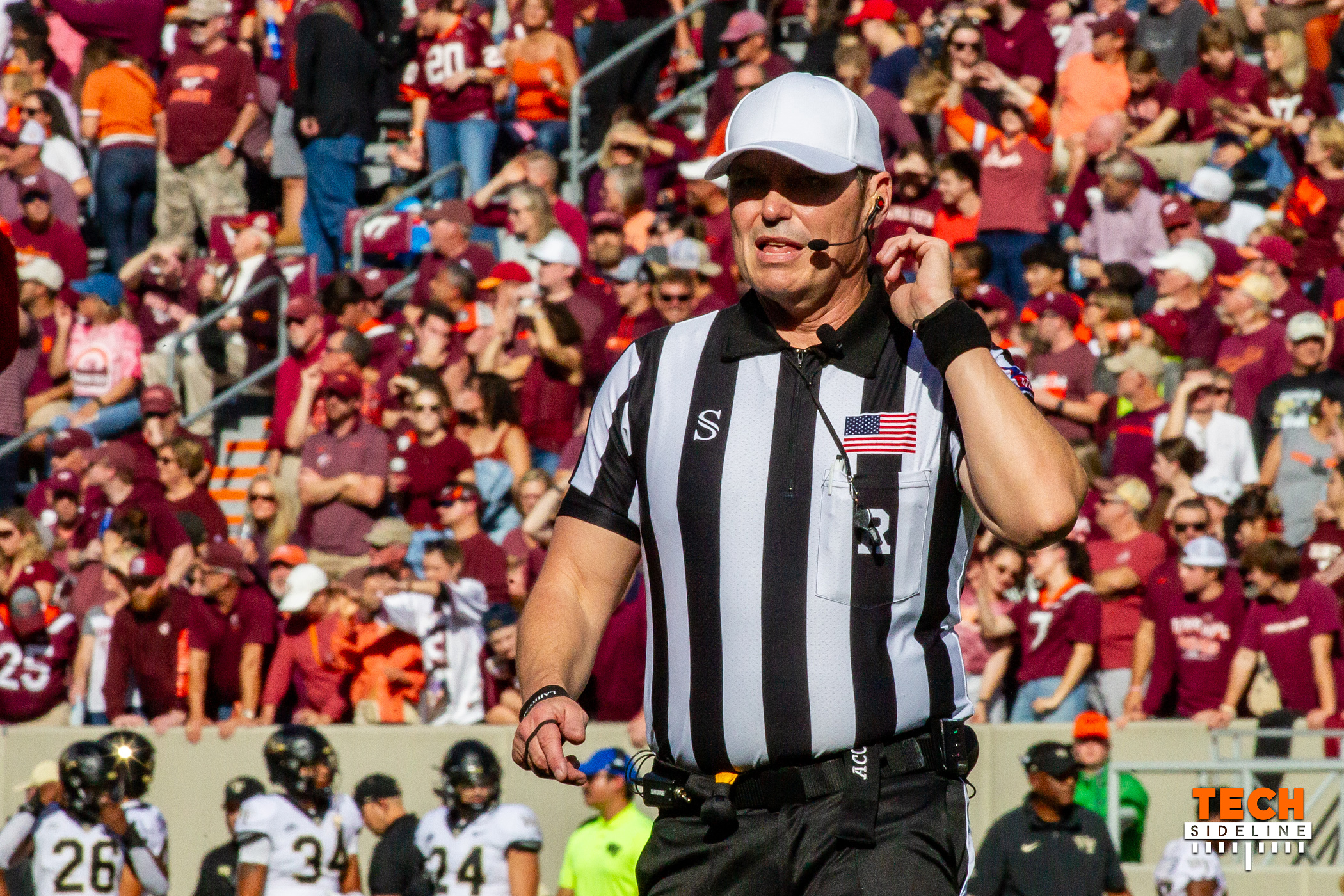
Before we get into the specific plays we’re going to cover today (and don’t worry, there will be more later in the week), I want to talk about what was a pretty rough viewing experience on Saturday.
Normally, I’m quite understanding of the officials (as several of you are pretty quick to point out). But for this game, I’m at a loss. For all the comments/tweets I saw about how this must have been the C-team of the ACC, crew chief Stuart Mullins is one of the best, most experienced white hats in the conference, having refereed a CFB semifinal and been an alternate for a national championship game. This isn’t exactly the training wheels crew, and so far this year, ACC crews have performed, in my opinion, very well (in Tech games at least — I can’t speak for other games I didn’t watch closely).
So what gives? Fair warning, this is going to be a bunch of speculation, and Mullins himself would be far more qualified to speak on this than I am, but I’ll give it my best shot.
In my opinion, it all comes down to game management and credibility. Let me explain. No, there is too much. Let me sum up:
Officiating a football game, at any level, is a monumental task. Our job, first and foremost, is to the safety of the athletes on the field and to provide them the best possible game experience. A huge part of that is managing the emotions of the game. And it’s an emotional game. There are 22 players on the field directly competing against each other, hundreds of teammates, coaches, and staff on each sideline, and tens of thousands in the stands, all living and dying with each play.
It’s up to the eight (or fewer) officials on the field to be the coolest heads and exercise the soundest judgment in every situation on the field. It’s also our responsibility to make sure that as much energy is devoted to playing (and watching) football, and as little towards non-football activities, as possible.
I have been in the exact situation that this crew found themselves many times in my officiating career, and it’s the worst. You just can’t catch a break. Maybe an unpopular call or a mistake by a crew member slows the game down or riles up a team’s coaching staff and fans. In that situation, the single best remedy is a nice, long, uninterrupted chunk of football to get everyone settled down in the flow of the game. That just never seemed to happen in the first half on Saturday, and it wasn’t always within the on-field crew’s control.
I can tell you, it’s immensely frustrating when you’ve screwed up (or even just made a tough but correct call), and all you want is for the game to resume… and then a guard false starts, and you’re marching off another penalty, and the players are getting frustrated, and the coaches are getting annoyed, and the fans are getting restless, and things start to spiral.
That spiral is what I’m talking about here. In that situation, frustration and penalties beget more frustration and penalties. Players get chippy, shoves and intensifying smack talk become more common and everyone in the stadium can tell things are about to get out of hand as events snowball.
To quote the Mikhail Gorbachev character from the HBO miniseries Chernobyl, “Our power comes from the perception of our power.” I’m sure some of you may take that officials-are-Soviets idea and run with it, but the core point remains: We as a crew maintain control of the game by the perception that we’re in control, and that’s where I believe this crew fell short on Saturday.
This control and credibility is why our mechanics are so important, and why you’ll see me nitpick the position of a SJ caught flat-footed on a deep pass, or a LJ trailing the play just a bit too far, or even inefficient communication when enforcing a penalty. If players, coaches, and fans start thinking the crew on the field doesn’t know what they’re doing, everyone gets frustrated, there’s more shoving and smack talking, more flags get thrown and the spiral worsens.
Much like the Fed raising interest rates to combat inflation, football officials really only have one major tool to fix this problem, and it’s one nobody likes: the penalty flag. Yes, some of the flags thrown were for false starts and the like, and there was a phantom facemask penalty that should have been waived off (probably the first objectively, definitively incorrect call I’ve seen so far from an ACC crew). But there were also some concerning signs in the first quarter that the game could get much messier than the crew wanted to deal with.
Quick side note: this is outstanding dead-ball officiating by SJ. It’s incredibly easy to fall asleep as it looks like things are settling down and everyone’s getting ready for the next play. Good on SJ here to stay alert and disciplined, with his eyes exactly where they’re supposed to be. More on that later.
If I’m evaluating this crew, I’d say it could have saved itself a few more headaches by flagging Kevin Pointer (#91) and Drones off the bat, instead of letting that situation play out, resulting in a single unsportsmanlike foul and further raised tensions. A pair of offsetting fouls would have been beneficial here.
To this crew’s credit, it eventually got things under control and had a pretty smooth second half, which is what one would expect from such a seasoned crew chief. In case you missed it from Will’s Monday Thoughts article, here’s a pretty mind-boggling stat:
“There were 13 penalties in this game, 11 of them in the first half.”
Again, the group eventually got it under control, but the process to get there could have been smoother had it acted a bit more decisively earlier in the game.
To be clear, this type of game control can be extremely difficult to execute, and it’s something I actually messed up this past Friday. There were a few things I let slide with just a talkin’-to early in that game that, if flagged, could have prevented bigger issues later (I ended up having to throw multiple dead-ball 15-yarders at a time due to how heated things got in the fourth quarter). That was a big mistake on my part, so I don’t blame this crew for doing what they did to get ahold of things, even if it made the first half just about unbearable to watch live.
This discussion now brings me to the ACC because I’m not sure the league did this crew any favors. In particular, I am fascinated by the sheer number of stoppages the booth buzzed down for (yes, it is a literal buzzer each official keeps in their front pocket), particularly the spots.
I jokingly posted on the TSL Subscribers Board that I blame the fans for those spot reviews. You all were going nuts about the on-field spots during the FSU game, so here you go, you animals. Here are your spot reviews. I don’t think the ACC actually took that approach, but boy, did it feel like it.
This game felt a lot like Week 1 where the booth was buzzing down for a review seemingly every other play. Sometimes it was for spots (a surprising number of which were overturned) and sometimes it was for targeting. According to Andy Bitter, it was five spot reviews, two targetings, and one sideline catch.
Five reviews for spots is, to put it gently, utterly nuts. I’m not sure I’ve ever seen that before. Watching live at game speed (admittedly just from the broadcast camera angle), none of the spots — even the ones that were overturned — seemed egregiously off.
But maybe that’s why I’m a back judge and not a short wing. Who knows?
I suppose one or both of the short wings had a rough day at the proverbial office, but that seemed to me like more a case of the replay official taking a very close look at things than the on-field officials missing something blatant. At the very least, the quality of this crew’s spots seemed consistent with what I’ve seen all year so far, and I’ll take consistency over sporadic pinpoint accuracy every time.
I’m all for getting it right, but I’d love to be a fly on the wall for that post-game crew debrief and/or whatever ACC meeting led to the uptick in replay reviews.
In conclusion, keeping the game running smoothly is a critical aspect of officiating. Whether it was due to excessive reviews, poor on-field spots or this crew failing to take control early in the game, what we saw on Saturday was a clear example of what happens when a crew — even an experienced one — struggles to keep the operation rolling.
That’s enough of my philosophical rambling for now, though. Let’s get into a couple of plays which hopefully illustrate the point I made above.
To Slam, or Not to Slam?
The Play(s): First, let’s look at the Jaylen Jones slam (am I the only one who hears the Space Jam theme playing every time I read that word?). This occurs only a couple of game minutes after the flag following the Drones run, so safe to say tensions remain elevated at this moment. Wake Forest has second-and-3 from its own 14 with the score deadlocked at 0 (insert Andy Bitter’s favorite Beamer meme here). Quarterback Mitch Griffis (#12) runs a nicely executed read option play and scampers for the first down. He decides not to slide in the face of a couple defenders, trying instead to juke out Jones for a few more yards, and finds himself airborne in the grasp of three Hokies. The Tech players drive him back and return him to the ground, drawing a very late flag.
The Rule: Personal Foul: 9-1
All fouls in this section (unless noted) and any other acts of unnecessary roughness are personal fouls.
Flagrant Personal Foul: 2-10-3
A flagrant personal foul is illegal physical contact so extreme or deliberate that it places an opponent in danger of catastrophic injury.