


“Man, the refs really screwed us on that one.” “We woulda won if we only had to play one team instead of two tonight!” [Insert meme of ref with sunglasses and a red-tipped cane here.]
I’ve seen it, heard it and even said it all at various points in my sports fandom. But how well did I really understand what these folks in their silly striped shirts were doing? Not well, evidently. At least until I started officiating myself; the depths of my ignorance were quickly made clear. But the more experience I gained as an official, I noticed something interesting: I became a better fan. I knew the game better, and have been able to enjoy it more and more ever since I donned my first striped shirt.
That’s really my goal for this series: to help my fellow Hokies better understand and enjoy this game that probably influences all of our emotional well-being a bit too much. The officials, after all, do play a substantial role in the game. They’re every bit as big a factor as the bounces of an oblong ball or the direction and strength of the wind. Plus, y’know, the rules are kind of important.
The plan is to break down a play every week or so (we’ll see what the season brings) in which the officials seemed to play an outsized role. I’ll examine what they did well, whether they were where they were supposed to be, the rule(s) involved, and whether or not I think they got it right. Officials are human, after all, and it’s possible one made a mistake which cost (or even handed) the Hokies a win. It’s also possible they may have nailed a quirk of this bizarre game we love so much in a way that, painful as it can be to admit, confirms our Hokies were simply outplayed on a given Saturday.
I don’t claim to be the best official out there — I’m starting my 8th season at the high school level this fall, with my fair share of playoff assignments and a handful of low-level college games under my belt as well. I’m sure there are a number of my fellow officials on the Tech Sideline subscribers board more experienced and knowledgeable than I am, and I hope you chime in when I’m off base! This isn’t meant to be all-encompassing or the end-all-be-all of college football officiating; at best, it’ll give us all a better appreciation of the game, and at worst, I guess it’ll be cathartic, if nothing else.
Before we get into the specifics of a given play, it’s important to learn a bit about the 3rd team (the best team, we tell ourselves before breaking our pre-game huddle) on the field.
For starters, let’s take a look at the mechanics — the positioning and responsibilities — of the officials on the field. I’ll go by position, briefly describing the keys (yes, officials have keys just like a linebacker or safety) and areas of focus of each member of the crew.
Mechanics: Where to Be and Where to Look
Referee (R):
Contrary to popular belief, there is one referee on the field. This my second-biggest announcer pet peeve (the first being calling a moving mass of players a rugby scrum — it’s a maul you ignora- never mind, not the point).
The R is the crew chief. He/she is the only one (in the modern game) to wear a white hat and has the final word in just about every situation in the game. Much like a quarterback, the referee has to know what every member of the rest of the crew is doing, and will need to take bits of information from each of them throughout the contest to properly apply the rules and keep the game running smoothly.
The referee will start most scrimmage downs to the throwing-arm side of the quarterback, a few yards behind and to the side. The quarterback is their primary responsibility — the referee will have to judge whether the ball was passed or fumbled, whether the QB was hit late, etc., as well as assisting on holding calls and other fouls in/around the pocket. Whenever the QB leaves the pocket, the R goes with him and stays with him until the play ends or the QB is clearly out of harm’s way.

Umpire (U):
The umpire runs the show in the interior. It’s a tough position — virtually every official you see getting laid out (or, much more satisfyingly, laying out some player) on ESPN is an umpire. The interior line is their primary area of focus, and they’re in harm’s way on just about every single down.
The umpire will pivot to assist on judging passes over the middle, but from the time of the snap, the U’s focus is almost entirely on their keys: guard-center-guard. Just like the linebackers around them, the U will read the interior line in order to anticipate the type of play that’s developing, and move accordingly to keep as clear a view as possible on action around the ball.
Traditionally, the umpire spots the ball and holds up the center if the defense is subbing (you’re welcome, Nick Saban), but the U has gotten some help in that regard in recent years.
Center Judge (C):
The newest member of the college football officiating crew, the C is essentially an R/U hybrid. The C will line up in the offensive backfield, more or less mirroring the referee, and judge the action on/around the line looking from the tackle in. They will often be the one spotting the ball in today’s game, allowing the U time to navigate linebackers as the defense gets organized. Like the R, the C will follow the QB if he rolls out to the C’s side and stay with him as long as is necessary to ensure nobody takes a cheap shot.
Short Wings — Line Judge (LJ) and Head Linesman (HL):
These are the officials on the line of scrimmage. Their job is to ensure the right number of offensive players are on the line and everyone is on their own side of the neutral zone until the snap. Once the ball is live, short wings have to read and react quickly. They’ll judge the legality of the snap, then key the near tackle, and finally check the closest back to determine where the ball is going and how.
The LJ will, as the name suggests, stay on the line of scrimmage and, well, judge the action near it — are any passes thrown from behind the neutral zone, does the ball reach the line when the QB throws it away, or are there any OL downfield when a pass is caught beyond the line?
The HL, on the other hand, will drift downfield a few yards as the play dictates in order to better judge action occurring further beyond the line. The linesman also is in charge of the chains, making sure they set up on the correct yard line and that they move at only the right times.
As the play develops, short wings’ primary area of responsibility will typically be the flat to their side, particularly when the action goes toward the far sideline. They’ll be responsible for judging whether and where the runner is down, keeping an eye on action directly around the runner (holds, face masks, etc.), and getting an accurate spot once the ball is ruled dead.
Deep Wings — Side Judge (SJ) and Field Judge (FJ):
The deep wings line up on the sideline around 20 yards downfield. Their keys are the widest receivers to their side, and they have deep-third responsibility. Essentially, they’re the cornerbacks in a cover-3 for 120+ plays per game.
The deep wings (and back judge) have a primary goal: Do. Not. Get. Beat. Deep.
It’s their job to keep the play boxed in at all times, ensuring there are multiple angles from which to catch critical information and hard-to-see fouls. If they read pass and the receiver(s) in their zone indicate a deeper route, the deep wings need to give ground to maintain a 15-yard or so cushion as long as possible. If a back busts a big one or a receiver runs a go route, it’s time to bail and take off deep and hope you have a big enough head start to not get beat.
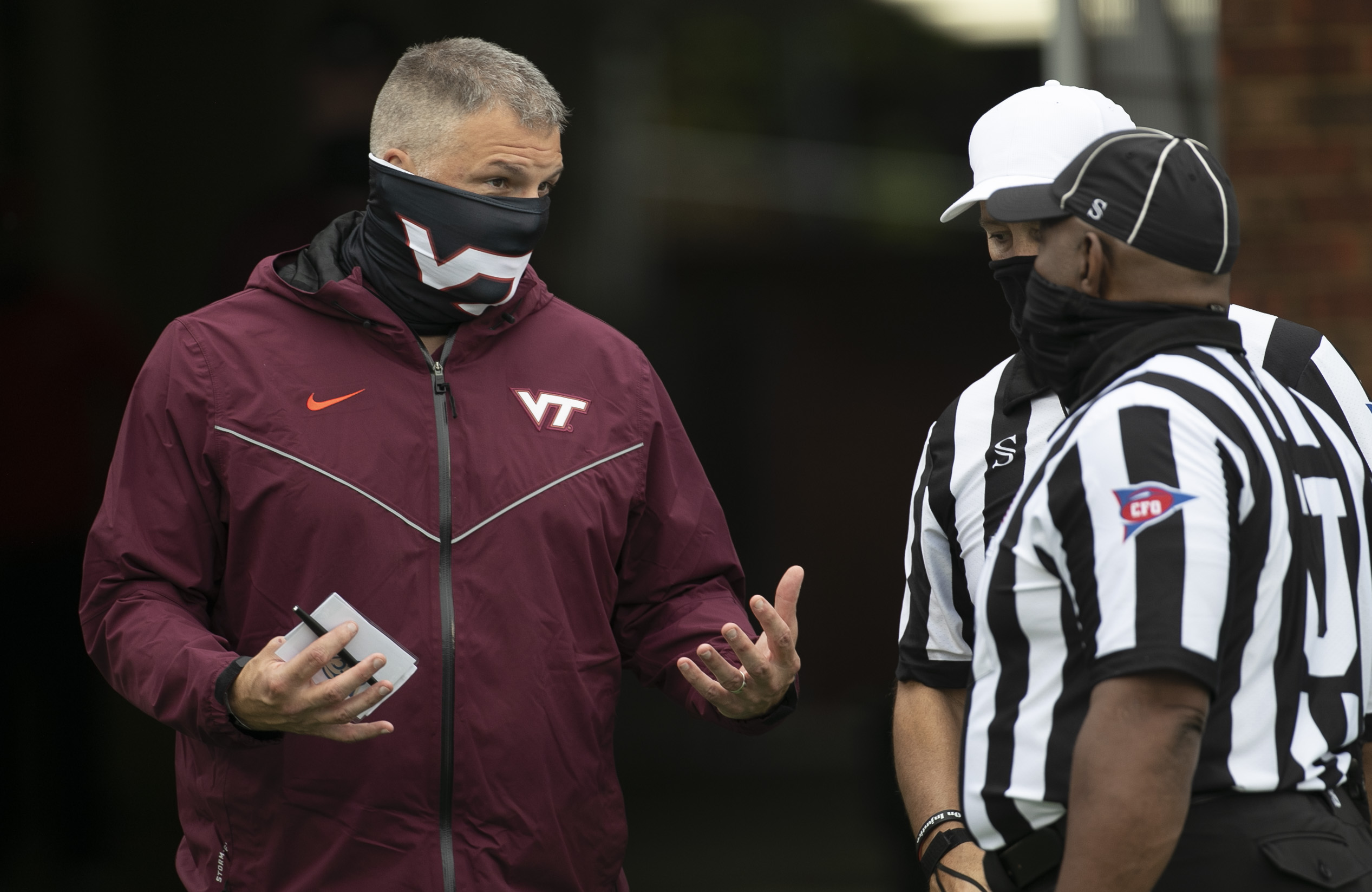
The deep wings are also responsible (along with the short wings, but they’ve usually got more to handle play-to-play) for keeping the sideline organized, safe, and respectful (lookin’ at you, Narduzzi). Whenever I’m working deep on the sideline, a key aspect of my job is communicating with the head coach and making sure he understands how the game is being called, as well as keeping the sideline clear so both short and deep wing officials can focus on the action on the field instead of dodging players, coaches, trainers, etc. on the sideline.
Back Judge (BJ):
The back judge is the free safety of the officiating crew. Along with the deep wings, the BJ absolutely, positively, cannot get beat deep. The goal line is the most critical line in the game (it’s the one which determines whether a team has scored, after all), and we need to be in position to accurately judge what’s happening around it.
The BJ’s key is typically the 2nd widest receiver to the passing strength of the offense, defaulting to the LJ side (the LJ has to stay on the line, remember) in a balanced formation. This can change depending on the style of offense played or a team’s tendencies, but regardless, once the ball is snapped, the BJ has their head on a swivel. It isn’t quite as dangerous as the traffic the U deals with, but there are few things as upsetting for a BJ as realizing the receiver on the far side has run a post and eaten entirely into your cushion without your realizing it. Been there, done that, it looks horrible on film [shudders].
As the ball nears the goal line, the BJ will, along with the deep wings, shift their focus from the goal line to the end line, ensuring they’re in position to judge catches and fouls in the back of the end zone.
The BJ will generally be responsible for the deep middle of the field, but will also provide a back-side perspective on action around the ball. As a BJ, my focus is on the point of attack whenever my zone isn’t threatened, and I’m looking for anything that might be a safety foul (blind side block or targeting, for example) or give one team a substantial advantage (such as a hold or block in the back).
Rules and Philosophies
Now that we know where everyone is supposed to be and where they should be looking, let’s wrap up with how they’re judging what they’re looking at.
First, the rules. Fun fact: there are a grand total of 12 rules in the NCAA football rule book. Yep, just 12. You can download the entire thing here yourself (and I recommend you do). Of course, within those 12 rules are several hundred sections, articles, and sub-sections, but still.
Any official working an ACC game must be intimately familiar with all 12 (in high school, we get off easy with only 10); knowing how to apply the rules and enforce penalties is the responsibility of every crew member, not just the referee. That’s a big reason why college officials will need years of experience before working those high-level games; there’s just so much nuanced and specific information to know, and you can never anticipate when some obscure rule might determine the outcome of a game. Decisions must be made in a split second, and you can’t exactly whip out the rule book mid-play to confirm you’ve made the right call (wouldn’t put it past a coach or two to try though).
I’ll reference this rule book throughout the course of this series to see which rules the officials are applying on a given play. The notation for the rule references will be presented as such: 2-4-3c, which corresponds to Rule 2, Article 4, Section 3c (I call this the Danny Coale rule. He caught that ball, dammit).
Even when the rules “seem” black and white, though, there are gray areas. A great example is holding. Check out rule 9-3-3b:
The hand(s) and arm(s) shall not be used to grasp, pull, hook, clamp or encircle in any way that illegally impedes or illegally obstructs an opponent.
Seems straightforward enough, but you know the old saying: they could call holding on every play. So why don’t they? In short: philosophy. We as officials need to judge whether a potential hold was enough of a restriction in close enough proximity to the ball to have an impact on the play.
I’ll expand on this idea more when we inevitably cover some holding calls throughout the season, but officials at every level will have explicitly defined philosophies covering holding, pass interference, targeting, formations, you name it. The goal is to keep things as consistent from game-to-game and crew-to-crew as possible, and to reduce the ambiguity and uncertainty in the rules as much as possible.
Some Closing Thoughts
So there you have it: the fundamentals of officiating football. I sincerely hope this series gives you a deeper understanding and enjoyment of the game, and that we can maybe take a minute to think through what an official saw and judged before busting out the proverbial pitchforks.
If you’ll indulge me, I’d like to end on a serious note: there is a shortage of officials across the country at every level in virtually every sport, and I can say from experience that fan/parent/coach interactions are a huge reason why so many excellent officials leave the field or court or mat for good. And it’s a real shame, because the ones who really suffer are the kids playing who don’t get as good a game experience as they deserve. My association around Richmond is moving to primarily 6-man crews from 7-man and trying to spread games between Thursdays and Fridays simply due to a lack of officials.
I joke that, “I’ve never had so much fun getting yelled at on a Friday night.” (And it’s true, officiating is a ton of fun! I’d strongly encourage anyone reading this to consider giving it a shot next season.) But I’ve also had to be given police escorts off the field on more than one occasion due to displeased fans (this isn’t the point, but the game film backed me up each time). Let’s be a better fan base than that. The game is too fun and too special to get bogged down in blaming the refs anyways.