

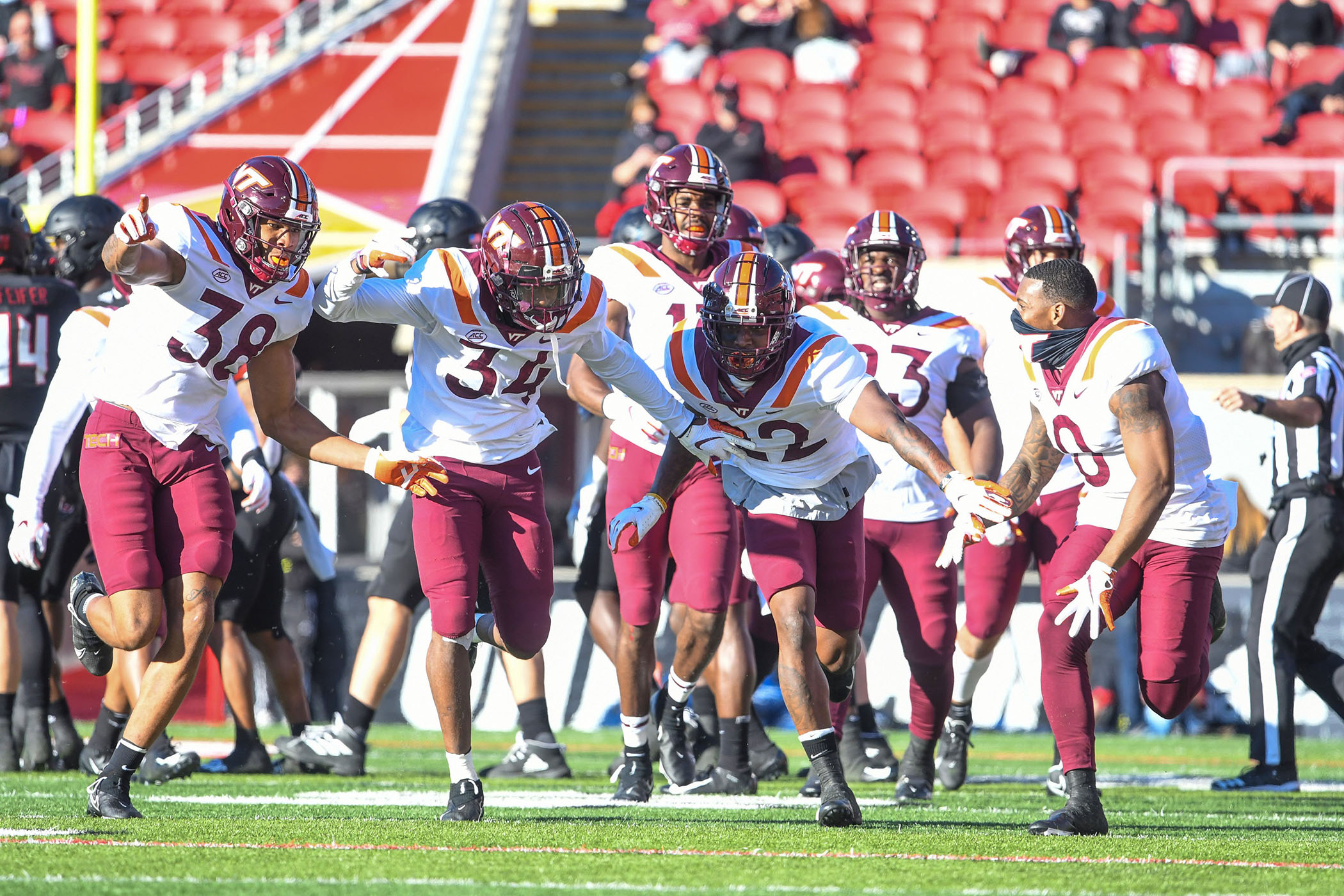
The eight days from the Wake Forest game through this Louisville game were an interesting time full of revelations and discussions about what exactly should be expected of this team and this coaching staff.
If you’re a regular Monday Thoughts reader, then you already know that one of the themes of the post-Wake Forest MT was that the Hokies had laid an egg as far as being emotionally ready to play, and the Deacs jumped out to a 10-0 lead. The Hokies never recovered from that.
I excused Virginia Tech for what I deemed to be the up-and-down nature of college kids being ready to play a football game on a given day. Sometimes they’re ready to rock, sometime, they’re not, and there’s nothing you can do about it.
That opinion, and some other things I said, struck a wrong note with many of you, and I addressed that in a Tuesday morning follow-up post on the subscriber message board. There was a lot more going on in the discussion than just the topic of being ready to play, but on that subject, I wrote:
The Hokies, even under Frank, have a loooong history of "not being ready" for games and losing to inferior opponents, so much so that I have accepted that that's part of college football. Most other programs do it, too. But does that mean we should accept it? Good question. You can argue that in order to punch above its weight, VT cannot show up without being ready to play. VT can't just give away 1-3 games a year because they're not ready to play at the opening kick. That was arguably one of the best achievements of the successful Boise State teams of the last 15-20 years -- they seemed to be always dialed in.
I spent a lot of time this week thinking about the topic, and no, I don’t have any iron-clad solutions for the professional coaches who make six and seven figures a year on how to motivate players. I just wondered if Virginia Tech would do a better job of “being ready to play,” however you define that. Sure enough, from the beginning of this game, the Hokies were the aggressor, and they set the tone early and jumped out to a 21-0 lead that was big enough to withstand twists and turns later in the game.
The Hokies came on strong, and Louisville didn’t. Being the more aggressive team from the opening kick arguably sets the tone for a lot of other things that happen: turnovers, penalties, red zone execution, and special teams, to name a few things. Virginia Tech only dominated one of those stats, turnovers, but that was enough.
Justin Fuente talked briefly last Monday night during Tech Talk Live about the attitude and demeanor of the team during the Wake Forest game, specifically, the players who don’t usually play during a game. “The guys who didn’t play, I wasn’t happy with them either,” he said. Discussions were had, and whatever the details were, it created some magic elixir that resulted in the team being dialed in and ready to go on Saturday. It made all the difference in the world.

Home Sweet Home
Aaron McFarling of The Roanoke Times wrote an interesting article that ran Saturday morning about how ACC teams had won a larger-than-usual share of home games in 2020. ACC home teams were 27-11 in conference play at that point, a “a .711 winning percentage — well north of the .539 winning percentage ACC home teams posted against conference opponents from 2015-19.”That article seemingly jinxed the home teams. ACC home teams didn’t fare as well on Saturday, going 2-3, but that record was affected by two of the league’s worst teams playing at home: Syracuse lost to Wake Forest, and Georgia Tech lost to Notre Dame. That’s as one would expect. Home teams went 2-1 otherwise, with No. 1 Clemson beating BC and 1-4 Virginia surprising 4-1 UNC in Charlottesville, 44-41. (That’s a lot of 1’s and 4’s.)
Louisville, however, couldn’t hold serve against the Hokies. That makes Tech 2-2 on the road, so the Hokies have fared better than the league as a whole when traveling. And they’ve traveled a lot. In the 15-team ACC, only three teams have played four conference road games: Virginia Tech (2-2), NC State (2-2), and Duke (1-3).
None of that is to excuse the Wake Forest loss. That was a stinker, one the Hokies would like to have back. It’s particularly painful when you look at the ACC standings, because the Hokies would be right up there at the top if they were 5-1 instead of 4-2.

Yes, I’m tempted to look at everyone’s schedule and start projecting things, but that’s a fool’s errand. There’s too much time left in the season, and any attempt to figure out if Virginia Tech could make the ACC Championship game is dampened anyway, when you recall that the Hokies face Clemson on Dec. 5th.
Speaking of Virginia Tech’s schedule, here’s the remainder of it:

Here’s hoping that the home-field advantage in this Year of COVID benefits the Hokies the rest of the way. With every game on television being so quiet, home or away, and without fans being allowed in Lane Stadium, it hasn’t really struck me how much of Tech’s season has been spent on the road. Now they’re coming home, except for that trip to Pittsburgh.
The key is to not relax. Whatever it was that created that team that started out strong on Saturday, bottle it and take a hit of it every weekend.

The Defense
How is it that I’m encouraged by a defense that gave up 548 yards and 35 points? I guess the answer is in the details.Louisville is the second most-talented offense the Hokies have faced, behind North Carolina. The Cards came in with a big-play reputation, and they lived up to it, burning Tech for a 90-yard TD run to close the first half and an 82-yard touchdown pass that was the first of three fourth-quarter touchdowns.
I'll leave it to Brandon Patterson to break those plays down, though there's no intrigue to the 82-yard catch by Dez Fitzpatrick; he just ran by Brion Murray.
There's a tendency to play the "take out those two plays and…" But that doesn't really get you a lot. Louisville still had 63 other plays for 376 other yards. That’s 5.97 yards per play. Where does that rank in this season's games?
- NC State: 5.1 yards per play
- Duke: 5.4 ypp
- UNC: 9.9 ypp (still makes me cringe)
- BC: 5.7 ypp
- Wake Forest: 4.8 ypp
5.97 yards per play would still be second-best for the season, behind only UNC. As it was, with those two plays Louisville had 8.4 yards per play (65 plays, 548 yards).
Maybe it was because the Hokies didn't give up as many long drives. Explosive plays are one thing. They're the result of a one-time mistake that is usually more easily correctable. Longer drives indicate you've got more serious problems stopping your opponent.
Here are the number of drives that went 8+ plays for the opponents:
- NC State: 3
- Duke: 4
- UNC: 2
- BC: 5
- Wake: 2
- Louisville: 3
No, that's not it. What about opponent drives of 75+ yards, regardless of number of plays?
- NC State: 2
- Duke: 3
- UNC: 6
- BC: 2
- Wake: 2
- Louisville: 4
Sigh. Nope, that's not a differentiator. Nor are TFLs, or time of possession, or third-down conversions, or red zone defense. I can't find a single statistical shred of evidence that says Virginia Tech played "better" on defense against the Cards.
Maybe the evidence is in the PFF grades, which Chris will provide later in the week. Till then, I guess what I saw was players playing harder, making more athletic plays, and passing the "eye test" more than I've seen at any other time this year.
I didn't see the interior of the Virginia Tech defensive line getting mowed over. The DL didn't distinguish itself, making only seven tackles on Louisville's 65 plays, which sounds like a miserable number, because it is. But they kept the linebackers cleaner than they had arguably all season. Alan Tisdale took advantage of it, playing the outside zone stretch to perfection on a few plays, slicing through gaps and picking up nine tackles, 2.5 TFL, and a QB hurry.
Justus Reed was more active than we've seen him since the NC State game. Mario Kendricks looked better than he has all season. Josh Fuga got his first TFL, a sack. The line played a pretty solid game, despite missing Jarrod Hewitt for the first half and Emmanuel Belmar for the whole game, and having to play an out-of-shape TyJuan Garbutt, who just rejoined the team last week. Virginia Tech had three sacks Saturday, and all three came from the defensive line.

There were issues on the back end, most notably with Brion Murray and Devin Taylor. But I feel like the defense bottomed out a couple of weeks ago and is starting in the positive direction.
In the crude, old-school metrics, this defense doesn't distinguish itself in very many of the major stats, residing outside the top 50 in many. Out of 103 ranked teams, the defense is:
- Total Defense: No. 83
- Rushing Defense: No. 76
- Pass Efficiency Defense: No. 54
- Scoring Defense: No. 61
- 3rd Down Defense: No. 52
- 4th Down Defense: No. 77
- Red Zone Defense: No. 51
- First Downs: No. 77
They are pretty good at sacks (No. 11), TFLs (No. 27) and forcing turnovers (No. 17), though. OXVT ran the numbers on those.


When we talked about the defense on this morning's podcast, I summed up my feelings by saying that I can see progress being made, and I can see what they're trying to do, but it's going to take time. It's not going to happen this year. They're working on getting taller, rangier guys in the front seven. At defensive end, for example, Justus Reed (6-3, 255) is a stopgap measure while they recruit and develop guys like Alec Bryant (6-3), Robert Wooten (6-3), Justin Beadles (6-5), Amare Barno (6-6), Cole Nelson (6-3), and Mattheus Carroll (6-5).
At linebacker, 6-3 Alan Tisdale has replaced 6-1 Dax Hollifield. The 2021 recruiting class has three players that we have classified as linebackers: Isi Etute (6-3), Jaden Keller (6-3), and Keli Lawson (6-4). 247Sports also lists Jack Hollifield (6-3) and Will Johnson (6-2) as a linebackers. We'll see how all those guys shake out, but the height, if recruiting profiles can be trusted, will be there.
The one factor that has limited this defense more than any other is the gutting of the defensive backfield, with Caleb Farley opting out, Jermaine Waller being injured, and Devon Hunter being suspended indefinitely. They are what they are, and it puts pressure on the offense. This week, the offense responded.
Third (and Fourth) Down Conversions
One area of concern for Virginia Tech is how poor they are at third-down conversions on offense. The Hokies are currently 24/70 on third downs, which is 34.3%, No. 78 in the nation out of 103 teams.
This is a trend for Justin Fuente's Virginia Tech teams. Third-down conversion percentage has gradually fallen:
- 2016: 42.5%, No. 46
- 2017: 40.8%, No. 57
- 2018: 37.3%, No. 82
- 2019: 38.5%, No. 81
- 2020: 34.3%, No. 78
I started thinking about how this year's Virginia Tech offense is more explosive, which means they would gain more first downs on first and second down, leaving fewer conversions for third (and fourth) down.
I decided to chart how many of the Hokies' first downs have come on first and second down, versus third and fourth down. Here's what I found, with yards per play (a measure of explosiveness) shown for reference. I also included the last four years of Frank Beamer's tenure at VT for comparison.

(This may be one of the more interesting things I've ever done. Or maybe I'm easily amused.)
Notice that the chart doesn't tell you anything about third-down conversion rates. It simply shows you how many first downs have been gained from the combination of first and second downs, versus third and fourth downs.
To no one's surprise, Virginia Tech's more-explosive 2020 offense (7.0 yards per play) has resulted in more first downs being picked up on first and second down (80 percent) than third and fourth down (20 percent).
Of course, a better third-down conversion rate would skew the percentages, but the 2020 third-down conversion rate of 34.3 percent isn't that different from 2019's 38.5 percent. If VT's 2020 rate was the same as 2019, Tech would have 27 first downs on third down instead of 24, and the percentages would go from 80/20 to 78/22 … not that big of a swing.
Point being, although 34.3 percent isn't good, it's effect on Virginia Tech's offense is diminished by how explosive the offense is on first and second down. That's Captain Obvious territory, but I thought it was interesting to look at the numbers.

It’s All About Turnovers, Just Like the Coaches Say?
Chris and I have been talking a lot lately about how there isn’t much talent differential in the “middle” of college football. Once you get beyond the very top teams, and before you get to the very bottom teams, the talent is fairly evenly distributed. Maybe it’s always been that way.Just scroll back up and look at those ACC standings. Clemson is super-talented. Down near the bottom, Duke and Syracuse and maybe even Georgia Tech don’t have much talent (though the Jackets are accumulating some). But beyond that, is there much difference between the levels of talent being fielded by Miami, VT, Pitt, and so on?
Louisville, for example, is No. 98 out of 103 teams in turnover margin. They’re tremendously talented on offense at the skill positions, but in their five ACC losses, their turnover margin is -10 (two per game). In the only ACC game they’ve won (FSU), turnovers were 1-1. They battled Notre Dame to narrow 12-7 decision, partly due to not turning it over.
In short, Louisville is 2-5 (1-5 ACC) because they stink at holding on to the football.
Virginia Tech loses the turnover battle 3-0 to Wake and loses a one-touchdown game. Virginia Tech wins the turnover battle 3-0 against Louisville and wins a one-touchdown game.
So … games are therefore pretty much decided by turnovers, penalties, twists of fate, and a handful of plays? That’s kind of maddening. Let’s just roll the dice. Why do Chris and I even pick scores for games?
Bullet Points
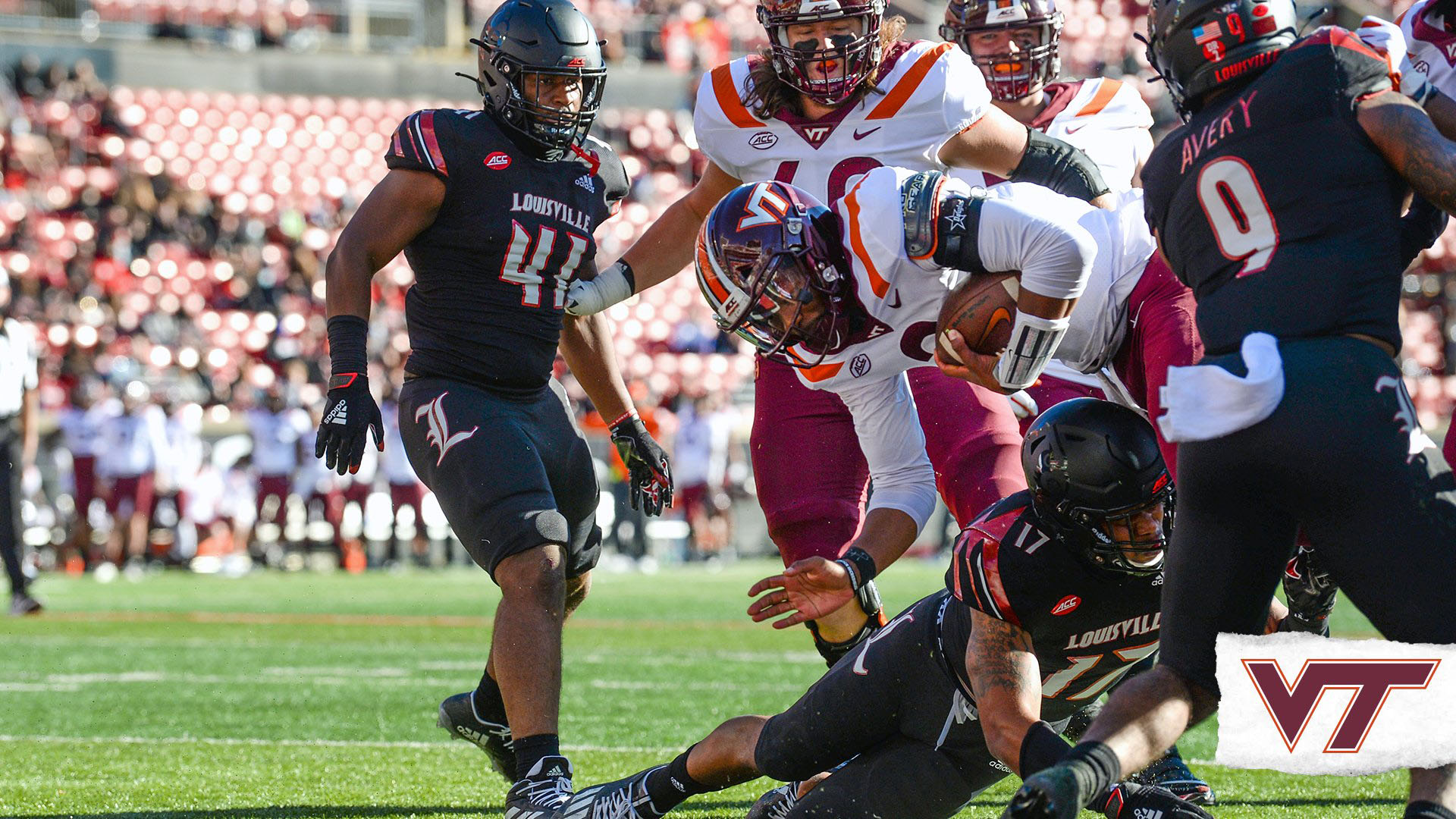
- Last week's red-zone disaster for the Tech offense reversed itself this week. Against Wake Forest, four RZ trips resulted in a whopping six points (1.5 per trip). Against Louisville, five RZ trips produced 31 points (6.2 per trip). That brings Virginia Tech's season average to 5.1 points per red zone trip, so this was an above-average outing. Chalk that up as another reason for the win.
- How about Dax Hollifield's enthusiasm on the sidelines, despite being bumped out of his starting role by Alan Tisdale? Dax started 19 straight games from mid-2018 through all of 2019, then started two of the first three games this season. That’s 21 starts in 22 games. He hasn't started the last three games, but on Saturday, he could clearly be seen whipping a towel in a frenzy, cheering his teammates on. Not to mention that I think Keshawn King fumbled a kickoff, and Dax recovered it. (The box score doesn't show that, though. Am I right on that?)
- Virginia Tech had a huge stop with 5:40 to go in the third quarter, while leading 28-14. Louisville had third and five from the VT eight yard line, and the Cardinals ran a trick play that was supposed to result in a throw to QB Malik Cunningham. (The TV announcers called it the Philly Special, but I don't think that's right, because it didn't look like this.) Justus Reed blew it up for an incompletion, and then Chamarri Conner picked Cunningham off on the following play.
- I could type lots more bullet points, but it's 4:05 PM. Time to wrap this up.
Next Up: Give Me Liberty
It's this simple: Virginia Tech needs to ignore that the jerseys say "Liberty" on them, and they need to show up ready to play. Turns out that might be the key to the whole season (with the exception of perhaps the Clemson game): be ready to play.Liberty features a dynamic QB named Malik Willis, who was once a Virginia Tech verbal. He later bailed and went to Auburn instead, where he had a cup of coffee before transferring to Liberty, where he is now No. 13 in the nation in total offense. We'll bring some detailed previews later in the week.