

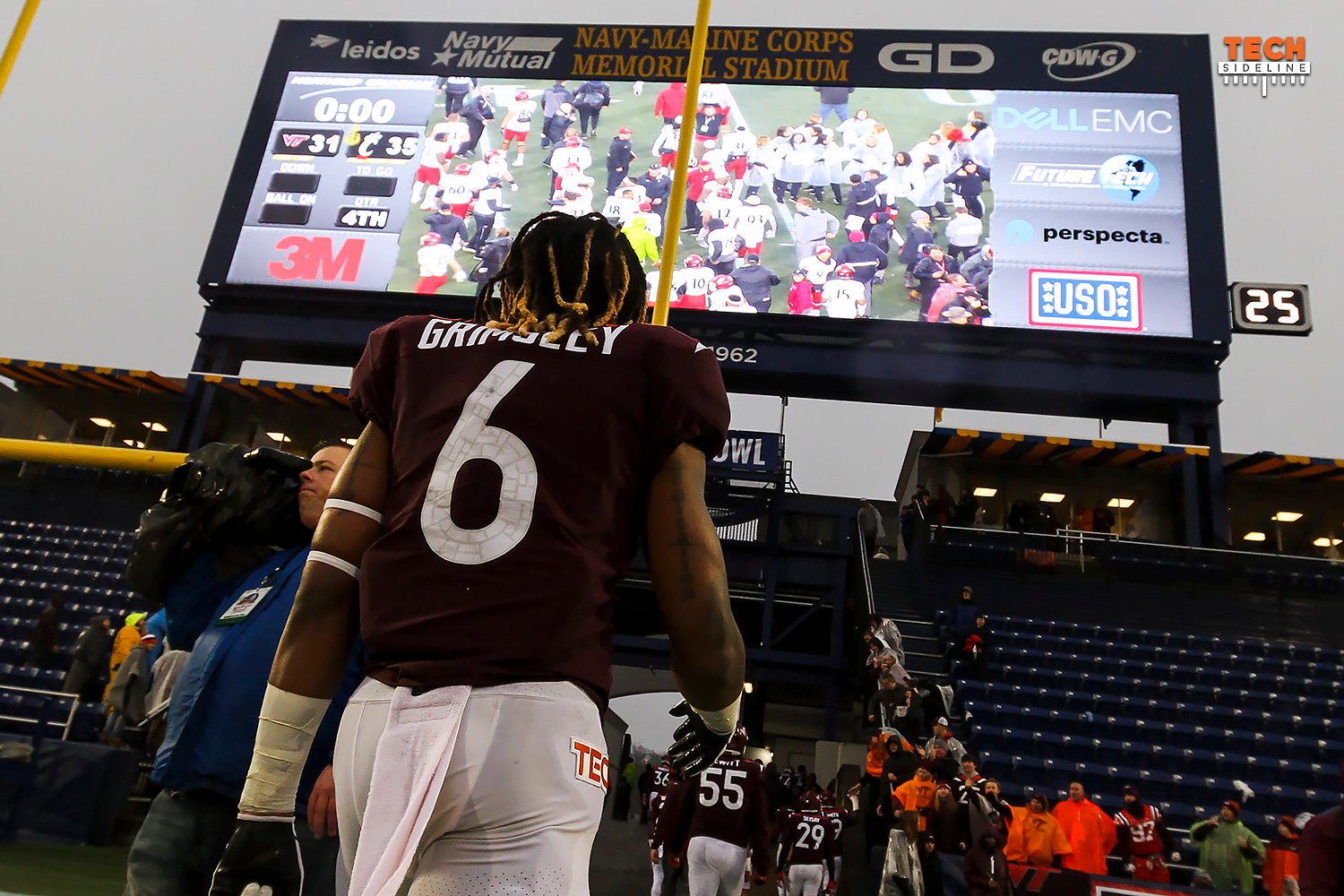
Sorry for the delay on this. I spent New Year's in New Orleans, from December 27 to January 2, and as you can imagine, I had a lot of catching up to do last week when I got home, so last week was shot.
Then there was the whole issue, once I had the time, of struggling to bring myself to watch this game. I wasn't very successful with that. I managed to watch most of the first quarter, then I didn't really see the point in it, because as Chris Coleman and later Brandon Patterson said in their follow-up articles, there wasn't anything to learn about this team. They are who we thought they were, and they played like it again.
I was nicely chastised via email by a subscriber who bluntly said that we (TechSideline.com) "got our butts kicked" in post-game coverage by other outlets. This reader wanted to see a discussion of coaching decisions, play calling, bad officiating, and, as a suggestion, "five reasons to be optimistic about the program."
Every one of those suggestions pushes a "no" button with me. That's not to trivialize reader feedback, which is vitally important. But I shy away from discussions of that nature.
Playcalling
Let's start with playcalling. It's one of those things where if a play worked, it was a great play call, and if it didn't work, then it must have been a lousy play call. The play call in particular, of course, is the fourth and one situation at the Cincinnati three-yard line. With the Hokies leading 31-28, Justin Fuente went for the jugular, wanting to go up 38-28 with about nine minutes left.
Ryan Willis got smothered as he attempted to roll out to the right.
Terrible play call, right? Not really. Hit replay over and over, and watch the following things:- 11 and No. 4 for Cincinnati cause all the trouble. They are blitzing linebackers, so the Bearcats were bringing the heat.
- Right tackle Silas Dzansi blocks down and whiffs on Bryan Wright, No. 11.
- Center Kyle Chung gets destroyed and shoved back into the backfield. This impedes pulling left guard Lecitus Smith, making it impossible for him to get across the line of scrimmage and help with blocking No. 4, Malik Clements.
Play over. If the Hokies hold the line of scrimmage, Dzansi gets his block, and Chung doesn't get completely blown up, the play has a chance.
But, by definition, if every play is properly executed, every play call is a good one, right? That's why I rarely talk about playcalling.
So it was a bad coaching decision to go for it, right? Virginia Tech should have kicked the field goal to go up 34-28. What did you think about the decision to go for it on fourth and two on the Cincinnati 42-yard line on the very first possession of the game? Geez, punt the ball. Don't give Cincinnati a short field on the first possession. But Fuente went for it -- the play call was great, by the way, and Chris Cunningham picked up 20 yards -- and the Hokies wound up scoring a touchdown to go up 7-0. You can't hyperventilate over the fourth-quarter decision and the fourth-quarter play call, without giving credit for the opening drive decision and opening drive play call. Fuente and Cornelsen created a touchdown where there wasn't one early in the game.
Remember Brian Johnson's missed field goal at the end of the first half? If he makes that, all else being equal, the Hokies are already leading 34-28 when they face that fourth and one with 8:56 to go, and it's a no-brainer: kick the field goal and go up 37-28.
When I first started writing for the site back in the 1990s, I used to agonize over every decision, every break, etc. Sometimes I still do. But I just don't feel like doing that with this game.
Officiating
This one is simple. Danny Coale caught that ball, right? Sure he did. We all know it. But that never should have mattered. Overtime never should have happened in that 2011 Sugar Bowl. By the time it came down to that, Virginia Tech had made so many coaching and playing mistakes and had suffered so many bad twists of fate that it turned what should have been a Hokies rout -- yes, I said rout -- into an overtime game.
I'm a hardline guy when it comes to this: if you're complaining about officiating, then you probably missed on a lot of other stuff along the way, and it's your fault that you've put the game in the hands of an official.
Officials are an unpredictable factor of the game, just like weather, bounces of the ball -- Cincinnati fumbled three times and recovered them all, including one for a touchdown, how about that? -- and injuries. Mountain West officials aren't going to be very good. Roll with it. Make enough plays that if the officiating crew spots the ball poorly or rules that a touchdown isn't one, then you can still overcome it. The other team has to do the same thing. Sometimes you'll get more officiating breaks than the other team, sometimes you won't. It's the way it goes, and I just don't think that you guys pay $84.99 a year to read me complaining about officials. So most of the time, I avoid it, though sometimes, I won't.
Five Reasons to be Optimistic About the Program
I'm really not a list guy. I think it's lazy writing and borders on clickbait (example: Ten Reasons Why the World Economy Will Crash by 2020). Some writers that I respect a lot do it, but it's not for me.
I much rather prefer to talk about issues within the program. So off we go.
Things that Keep Me Up at Night
I used to work for a guy who had a way of cutting to serious discussions about whatever we were working on. He would ask, "What keeps you up at night?" He wasn't interested as much in what was going well. He wanted to know where the pitfalls were, and head them off at the pass.
I'm often reminded of that question, and it surfaced again when I read this glass-half-empty post by ScottsdaleHokie on our subscriber board a few days ago.
On Twitter, people often say that "retweets do not equal endorsements," and in this case, linking to Scottsdale's post doesn't equal an endorsement of the post. I disagree with some of the seven points he makes.
But he does list some things that keep me up at night.
Youth vs. Talent
From ScottsdaleHokie's post:
"I don't believe inexperience is the problem on defense. I believe it is a lack of talent. In other words, I don't think our young players this year will be measurably better next year."
We've been debating this all year, and to be clear, the discussion centers more around Bud Foster's historically-bad defense, not so much around Justin Fuente's offense.
Let me show you a couple of plays that encapsulate what we're talking about when we discuss youth vs. talent.
Watch the following:1.) TyJuan Garbutt, No. 45 playing left defensive end, crashes down the line, losing containment.
2.) Bryce Watts, No. 5 playing left cornerback, gets annihilated by a blocker. Watts eventually gets pushed out of bounds and disappears from the frame.
3.) Reggie Floyd, No. 21 playing rover, takes what I think is proper leverage but never gets off the block and isn't involved in the tackle.
4.) Khalil Ladler, No. 9 playing whip, is admittedly some distance from the play, but he never does more than a jog-and-watch. I'll give him a break on this one, but it wasn't exactly maximum effort.
Garbutt actually ends up making the "tackle," pushing Michael Warren out of bounds at the end.
Some of these things, most notably Garbutt crashing down the line and losing contain, are mental issues that can be cleaned up. But we have been watching Virginia Tech's cornerbacks get blown up and display a penchant for bad tackling and non-physical play all season long. This isn't the first time I've noticed a VT corner being driven out of bounds and out of the play.
It's realistic to expect Garbutt to become a better player, but what sort of turnaround can Watts make from that sort of play, to one where he is physical, stands up to the blocker, and maybe even sheds the block to be involved in the play? That's a huge leap from what you see in that piece of film.
Here's another one:
Watch:1.) Dax Hollifield is isolated in coverage and overcommits to the possible wheel route, leaving himself vulnerable inside.
2.) No one else shows up. Reggie Floyd takes a leverage position against the blocker, but doesn't make an effort to shed the block and make the tackle. Khalil Ladler continuously backpedals without making a commitment, taking on the blocker, or forcing leverage. He's a non-factor in the play.
Dax will never be able to consistently play that sort of situation. He is a mike linebacker, not a backer. He's playing out of position. Until Virginia Tech finds a true backer, their vulnerability to that sort of play will be there.
Floyd and Ladler need to show more "want-to," and that's fixable. But will it be fixed?
What I don't know is how Virginia Tech wound up in this position where there is so much soft play going on with the defense. Some of it is physical, but some of it is also mental. This defense isn't the foaming-at-the-mouth crew that they were … no, I'm not going to say "back in Beamer's heyday" … just a few short months ago, against Florida State.
Some of it is their young minds tying up their feet, but some of it isn't. Some of it will get better … but some of it won't.
I think Virginia Tech is a long way away from fielding a top 20 defense again. Never mind top 10. I think top 20 is a stretch.
Job one is getting the defense to the point where they don't do this with the game on the line:
The Offense Looks More Encouraging
If you accept for the time being that the Virginia Tech defense is a far cry from being what it used to be, that shifts the burden for winning to the offense. On that side of the ball, the situation is much more encouraging.
For much of the season, I harped on the offense's inability to score 30+ points, and to give credit where credit is due, they averaged 35 points per game over the last three outings:
- Virginia: 34 points
- Marshall: 41 points
- Cincinnati: 31 points
I like the way offensive line recruiting has gone, and the line that the Hokies put on the field in the bowl game is promising. Lecitus Smith and Christian Darrisaw have bright futures, and I think Silas Dzansi does too, though he was spotty in this game.
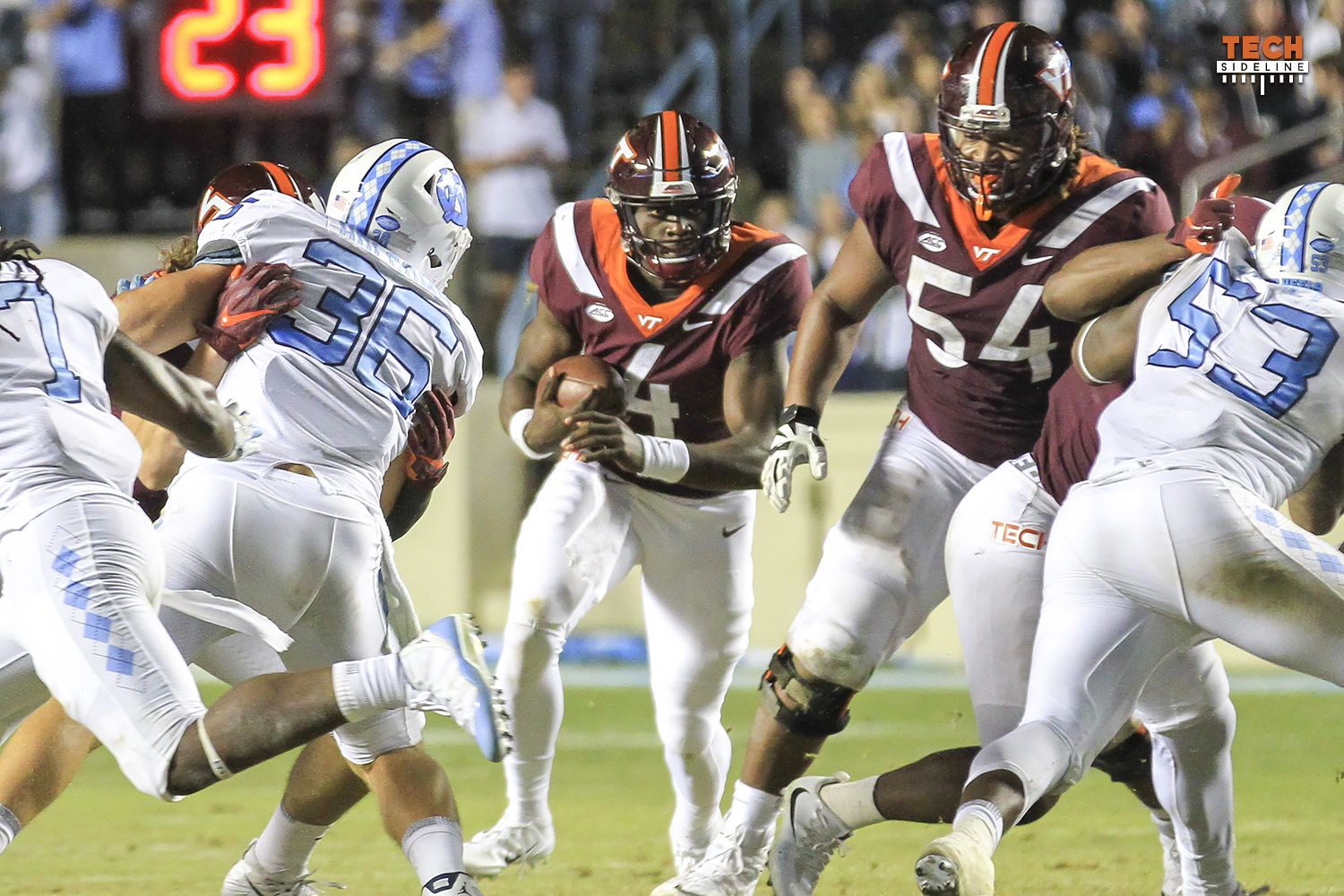
There were some really well-blocked running plays in this game. Here's a small sampling, picked out at random. Nothing earth shattering, but plenty of room to run.
Yes, Marshall and Cincinnati are not Power 5 defenses, but they were good defenses, and the Hokies averaged 36 points, 449 yards, and 183 yards rushing (4.4 yards per carry; take out sacks, and it was 5.0 yards per carry). Marshall wound up as the No. 8 rushing defense in the nation, Cincinnati as the No. 13.Not every one of the young offensive linemen is going to be a keeper, but on the whole, I think the replacements for outgoing seniors Kyle Chung, Braxton Pfaff, and Yosh Nijman (who didn't even play the last three games after getting hurt against Miami) are going to be upgrades in the long term.
The wide receiver corps is young and deep, the tight ends are a solid group, and the running backs do fine when the blocking is good, though I wish Tech had a game breaker. There's only one position left to discuss.
Quincy's Burden
Here, buried in the middle of another long Monday Thoughts, is the underlying theme of my thinking and writing for the next 2-4 years: the future success of the offense, and perhaps the entire Virginia Tech program, rests on the shoulders of one young man: Quincy Patterson.Hyperbole? No. Hyperbole would have been to say it the day he committed to the Hokies in February of 2017, or when he signed with the Hokies over a year ago, in December of 2017. My statement is a reasoned observation, based on program trends, recruiting, the depth chart, and the way the wind blows.
Duh. Good teams always have good quarterbacks. But hear me out.
Justin Fuente is now three years into his tenure at Virginia Tech, and the program has steadily gotten worse in those three years. In the preseason, I thought the program would bottom out, record-wise, in 2018. It has, posting the first losing season in 26 years, and thus breaking the longest active streak of winning seasons in FBS football.
Now what? If Justin Fuente is the guy for Virginia Tech and will be their coach of the future, then as his blueprint for the team takes shape, the Hokies should get better in the next few years, perhaps in 2019, but definitely in 2020 and beyond.
That improvement will be driven by the offense getting better as players mature and develop, and the defense improving at least marginally in the next few years.
How much better the team gets will be determined by how good Quincy Patterson becomes.
If Patterson is another Logan Thomas, a spotty passer who never improves and instead becomes a read-option battering ram, then Virginia Tech will be a so-so team, struggling to get beyond eight or nine wins (which isn't awful; it just probably won't be Coastal Division championship material).
If Patterson is solely a running QB who never progresses beyond making one read in the passing game and taking off, then Virginia Tech's offense isn't going to get much better, and with the defense looking the way it is, that's not a formula for winning a lot of games.
If, however, Quincy Patterson becomes what everyone hopes he can be, a skilled, powerful executor of the read option running game and a passing QB who can check down his reads and make all the throws, Virginia Tech football is going to get very exciting in the next few years.
Quincy Patterson's career arc may decide Justin Fuente's career arc.
This isn't anything new to Fuente, or most coaches frankly, and this is the situation he has built. He has hitched his wagon to Quincy Patterson, and Patterson will either carry him onward and upward, as Paxton Lynch did at Memphis, or Quincy will be, pardon the melodrama, Fuente's failed gamble.
Such is life on the fringes of the Power 5, where Virginia Tech finds itself after seven conference championships from 1995-2010, but only one division championship in the last six seasons.
Let's get back to ScottsdaleHokie's post.

Player Attrition and Culture of the Program
"…whatever the reason we are getting rid of too many players. At some point, this comes back to the coach."