


If you've been reading Monday Thoughts for a while, and I know most of you have, then you've heard me say it before — there's always that game every season where you have that moment of clarity about who you are. This was that game.
It started with the Clemson game, where we all drew the brilliant conclusion, "Clemson has better players. Virginia Tech needs better players." That's not wrong, but I think this game brought things into sharper focus. More on that later.
This game was disheartening. Miami controlled it from start to finish, except for one brief stretch where the Hokies had a chance to turn the tide. The Canes won 28-10 and outgained Tech 429-299, but I think you'll agree that it felt worse than that. It felt Saturday night as if the Miami program put the pedal down and pulled way ahead of Virginia Tech.
It felt that way … but it's not as bad as it felt, in the same way that Tech's 37-16 thrashing of Miami last year in Lane Stadium, a game the Hokies controlled from start to finish, didn't say a thing about what would happen this year or in the future.
I've been saying in print and in the podcast that Miami and Virginia Tech need to stop messing around with the rest of the Coastal Division. They need to take control of the division and wage annual battles for the Coastal championship, as two ranked teams. They need to build the same hype around their game as Clemson and FSU have around their matchup.
Guess what? It's already happening. Here's a list of Coastal champions from 2005-2011:
- 2005: Virginia Tech
- 2006: Georgia Tech
- 2007: Virginia Tech
- 2008: Virginia Tech
- 2009: Georgia Tech
- 2010: Virginia Tech
- 2011: Virginia Tech
Okay, I like the way that looks. Now from 2012-2015:
- 2012: Georgia Tech
- 2013: Duke
- 2014: Georgia Tech
- 2015: North Carolina
Really? Really? What the heck is that? Duke? UNC? More Georgia Tech? Give me a break. That's as bad as the Atlantic Division from 2006-2008, when the champions were Wake Forest (2006) and Boston College (2007, 2008).
Now look at the last two years.
- 2016: Virginia Tech
- 2017: Miami*
* Miami hasn't mathematically clinched, but Virginia, the only other school with a mathematical chance, isn't going to win it.
The Atlantic got their stuff together starting in 2009, and it has been nothing but Clemson (four division titles) and Florida State (four) in the last eight seasons, with Clemson holding the inside track to winning it again this year.
I think the Coastal is on a similar course and is going to look something like this for the next decade:
- 2018: Virginia Tech
- 2019: Miami
- 2020: Virginia Tech
- 2021: Miami
- 2022: Virginia Tech
- 2023: Miami
- 2024: Virginia Tech
- 2025: Miami
- 2026: Virginia Tech
- 2027: Miami
This is a good thing. As bad as Saturday night was, the Hokies and Canes rivalry, which has always been a good one, is important again.
That's the good news. It's the only good news from Saturday night. Sorry about that.

The Importance of Wide Receivers to Justin Fuente's Team
I alluded to the Clemson game earlier, and how we all realized the Hokies would need better players to compete with the likes of Clemson. Here's the key paragraph (bold emphasis added) from my Monday Thoughts on that game:It’s easy to torture yourself with what-ifs, and there have been fans questioning the play-calling on offense and the decision to fake a field goal late in the game. That’s natural for fans to do that. But what I will always remember about this game is how physical Clemson was, and how the Hokies couldn’t get Clemson QB Kelly Bryant to the ground at critical moments, most notably that near-sack near the Tech goal line half way through the third quarter, when Andrew Motupuaka and Emmanuel Belmar both had great shots at Bryant, but couldn’t wrap him up for a big loss.
That's a pretty simple take — get bigger, faster, stronger players.In this game vs. Miami, the take was more precise: get bigger, faster, stronger wide receivers. The lack of wide receivers who could get separation against Miami's defensive backs and make plays was a problem that trickled down and affected every aspect of the offense — execution, the game plan, the resiliency, the chance to be opportunistic … all of it. Justin Fuente talked about winning one-on-one battles, and he was specifically talking about wide receivers beating defensive backs for chances to make catches.
He didn't talk about Tech's running game, or Miami's sacks and tackles for loss. He talked about turnovers, but then quickly switched the topic to winning on third down. Who wins on third down? Wide receivers.
As Ricky pointed out in his game recap, the Hokies averaged 6.4 yards on first down. I just took a quick spin through the play by play, and up until it was 28-10, the Hokies only lost yardage on first down twice, out of 24 plays. They had no gains another 3-4 times. They weren't getting killed on first down, they just couldn't convert third down, going 3 of 14 for the game.
Against Clemson, the Hokies were 4 of 15 on third down, for a combined 7 of 29 (24.1 percent) in their two losses. In their seven wins, the Hokies are 48 of 112 (42.8 percent).
I'm starting to develop a theory about Fuente, which perhaps you smarter football minds out there can agree or disagree with. First of all, we all agree that quarterback is the most important position on offense, correct? Beyond that, most people say that an offense starts with the offensive line, but I think Fuente prizes wide receivers as much or more than he does offensive linemen.
You can build an offense from the inside out, like say, Wisconsin does, or Boston College. Those schools are renowned for strong offensive line play and a strong traditional running game.
Just like true centers are in short supply in college basketball, good offensive linemen are in short supply in college football. Buzz Williams has packed his basketball team with an ever-increasing supply of high-quality wings and guards, and a limited number of post guys. He has already taken Virginia Tech to an NCAA Tournament in just his third season with that philosophy.
I think Fuente wants to start by beating you on the perimeter with good wide receiver play. That spreads your defense out, and he prefers to then use misdirection to pick up rushing yards. You don't need to do a great job blocking guys if you can just get them to be in the wrong place. You can scheme an offensive line into looking better than it is, provided your skill position players can execute the scheme.
Saturday night, deathly afraid of turning the ball over, the Hokies started with the running game and played it conservative. But the reason they formulated that conservative game plan is because they didn't have confidence in their wide receivers to win one-on-one battles … and they were right.
Missing Jerod and Isaiah, and Yes, Bucky
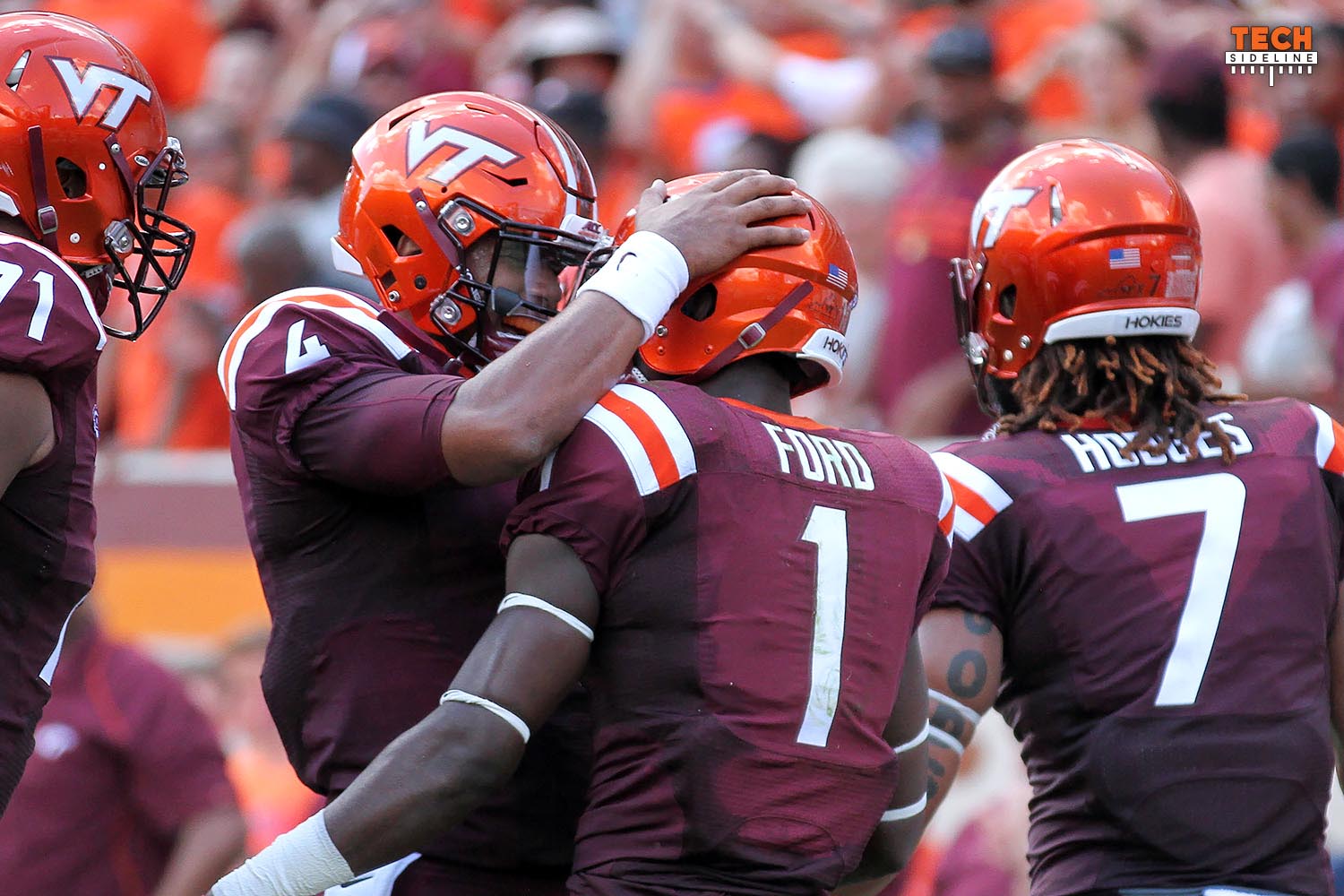
I didn't come out of the Clemson game wishing Jerod Evans and Isaiah Ford were still playing in Blacksburg, but I did have that feeling after this one. I even missed Bucky Hodges.As bad as this result was, it could have been a different game with those three guys playing. Ford and Hodges could have gotten some separation, particularly Bucky on the slant, and of course, having Ford and Hodges on the roster means that Cam Phillips would have been in the slot, making guys miss. (Phillips had a great 32 yard play late in the game where he took a simple flanker screen, broke a tackle, and raced up the sideline.)
Evans was criticized for being a one-read-and-run guy, and that's fair. Josh Jackson is a better "quarterback" who can progress through his reads and manage the game better. But in case you didn't notice, here's a news flash — this was a one-read-and-go game. Miami was bringing the heat, and there wasn't time to progress through multiple reads.
Evans would have thrived in this game. Without the wide receivers getting separation, the quarterback running game — excuse me, the quarterback scrambling game — came into play, and Evans would have been a bull. This was the time last year where Evans started throwing down in the running game. He had three rushing touchdowns in Tech's first eight games in 2016, but then piled up nine rushing touchdowns in Tech's six games after Nov. 1.
Evans also had a competitive fire and an ability to pick the team up and carry them on his back, mainly by plowing through tacklers and then hitting a big pass on the next play. One of the things we heard via sources back when Evans decided to go pro is that while he has his weaknesses as a quarterback, the coaches really liked his competitiveness, and they were concerned that while Josh Jackson is a better quarterback with a higher ceiling, he perhaps lacked the ability to crank it up in crunch time through sheer force of will. We're seeing that now. Evans was listed at 6-foot-3 and 238 pounds, while Jackson is listed at 6-foot-1 and 215 pounds. One of those guys goes down easier than the other.
To the larger point, with Jackson at the helm, the machine is quicker to break down when you don't get good wide receiver play. There aren't many options beyond that. When Evans, Ford and Hodges left, they took qualities with them that are lacking on the current team. It hasn't mattered against everyone not named Clemson and Miami. Tech can win a lot of games with this coaching staff and these players, but they bang their head quickly against the ceiling when going up against better teams.
The Narrow Window for Success, and How it Closed
Despite all that, the Hokies had their chance. They picked off Miami's Malik Rosier three times in three straight possessions, 1998-style, and had a chance to turn the tide of the game. Yet, they scored just seven points off those three turnovers.
The interceptions started when the score was 14-3 with 53 seconds left in the first half, and all three interceptions and the follow-up drives were over with 7:59 to go in the third quarter.
That was an eight-minute window that could have turned a game that up until then — and after then — was a mismatch. In the best-case scenario, the Hokies convert all three turnovers into touchdowns to take a 24-14 lead, and Miami starts to come unglued.
But when the sequence ended, it was 14-10, Miami, the potential wasted.
First interception: Tech starts at their own 33-yard-line and drives quickly down into Miami territory, only to have Sean Savoy fumble on a great hit at the Miami 12-yard-line.
The Hokies only had three plays of 10-plus yards prior to this interception, but then they ripped off consecutive gains of 10, 12, and 27 yards to get to Miami's 18-yard-line. They made a stellar play call to spring Savoy up the middle on the tunnel screen, but disaster ensued.
Second interception: Reggie Floyd picks off Rosier at the VT 46-yard-line, then rumbles to the Miami 17-yard-line.
Forgotten in all the discussion of turnovers by Virginia Tech, big plays by Miami, and Tech's "horrible offensive line play" is the fact that the Hokies manned up and ran it right at Miami after this interception, scoring in five straight rushing plays. The Hokies ran up the middle (two yards), up the middle (six yards), jet sweep (six yards), up the middle (two yards), and up the middle for the touchdown (one yard, quarterback sneak).
Nothing cute, nothing fancy, just go right at them, with a jet sweep mixed in. 14-10, Miami.

Third interception: Greg Stroman intercepted Rosier at the VT 45-yard-line on a great play, and the Hokies drove it to the Miami 32-yard-line before misfiring on a fourth and two.
This was the play where Sean Savoy went into jet sweep motion and ran across in front of Josh Jackson as the ball was snapped, resulting in a loose ball and a turnover on downs. I don't remember that happening all season long, or even last season, do you? Terrible timing for it.
Reggie Floyd's Personal Foul
Everyone talks about what happened next — the personal foul call on Reggie Floyd that was questionable at best, terrible at worst. But Tech had their chance to take the lead and put the pressure on Miami leading up to that, and they didn't.
As for the call on Reggie Floyd, yes, it was a bad call. Floyd hit Rosier as Rosier was carrying out a play fake, and Floyd was flagged for a personal foul. It wasn't even a dirty hit, it was just a hit.
There's been a lot of talk about how that play "turned the game." I don't know. It was second and seven on the Miami 42-yard-line, and the play was stopped for no gain, resulting in a third and seven. But instead, Miami got a first down at the Virginia Tech 43-yard-line.
It's not like the Hokies got a third-down stop, or a turnover that was overturned. It was an otherwise unremarkable play, and the Canes still had 43 yards of green grass between them and the end zone. Which of course, Miami erased on the next play, when tight end Christopher Herndon IV did his best "Jeremy Shockey runs over Kevin McAdam" and shook a tackle by Floyd to race down the sideline and score.
That should have been about a ten-yard gain, but instead, it was a touchdown that made it 21-10. Psychologically, it was very important, because VT had failed to take proper advantage of three straight picks, and then Miami swung the momentum back their way.
If you want to blame the personal foul call for "turning the game," also blame both Savoy fumbles, and Reggie Floyd's missed tackle. It was all part of a sequence that slammed the door on the Hokies.
Speaking of Reggie's missed tackle…
Missed Tackles Take Their Toll
In reviewing the game, I decided to highlight all the missed tackles I saw by Virginia Tech, and how many yards after first contact (YAFC) Miami picked up.
I only counted seven missed tackles, though admittedly, one play had two missed tackles. Does that number surprise you? Did you think it would be higher?

Well, there are missed tackles, and then there are missed tackles. Earlier, I referenced Jeremy Shockey running over Kevin McAdam in the 2000 game down in Coral Gables. That was 17 years ago, and I still remember it clearly. Miami led 14-0 at the time, and McAdam's missed tackle and Shockey's 44-yard touchdown meant the rout was truly on.
By my calculations, five of the seven missed tackles resulted in 35 extra yards gained by the Canes. None of them were critical third-down gains, nor did they result in scores.
The other two were killers. Andrew Motuapuaka missed a tackle on Travis Homer (D'oh!) four yards beyond the line of scrimmage, and Homer housed it from 60 yards out. Here's Homer after the missed tackle.

Look at that. There's nobody within 15 yards of him. He's skipping into the end zone.
The other missed tackle was Reggie Floyd's late-arriving attempt at an ankle tackle on tight end Christopher Herndon. Floyd got caught up in traffic as Herndon crossed with a receiver, but still had a chance to take Herndon down from behind about ten yards beyond the line of scrimmage, at the Tech 32-yard-line. Floyd missed it, and Herndon took it all the way home (look, another house reference), feeding off a great block by Ahmmon Richards, who ate up Greg Stroman.
Those are two missed tackles that resulted in 92 extra yards of offense and two touchdowns. Motuapuaka took himself out of the play on his missed tackle, winding up on the wrong side of Miami lineman Navaughn Donaldson (6-foot-6, 350 pounds) and blocking himself from seeing Homer. Donaldson is No. 55 in this screen shot, and you can't even see Motuapuaka.

It's hard to say what everyone's gap responsibility is on this play. Settle and Mihota are coming up a gap together, with the middle vacated. If Settle had gone right instead of left at the snap, he would have planted Homer in the turf a yard behind the line of scrimmage. But again, we don't know what his gap assignment was.
Oh, well. As many have written, the Hokies needed to prevent the Canes from making explosive plays, and Tech needed to force Miami into third down situations. They didn't. Miami scored four touchdowns while only facing eight third downs.
Tech opponents had been averaging 16 third downs per game through Tech's 7-1 start; Miami faced half that many. In a game where this was the biggest statistical advantage the Hokies had, it wound up being a non-factor.
I don't really want to rehash the game anymore, though. That's been done to death.
Patience Required
Last year's Coastal Division championship and near-defeat of Clemson in the ACC title game probably gave us all a feeling that this program was further along than it really is. The early departures of Jerod Evans, Isaiah Ford and Bucky Hodges have left the offense nearly devoid of playmakers, and next season Cam Phillips will take his 223 receptions (and counting) elsewhere.
This program needs better receivers and better running backs, and it could use a playmaking quarterback (not just a game manager). Jackson is a good quarterback who can't make magic happen when the play breaks down, and he'll get better as time goes on, but he won't be a dynamic playmaker.
As for running backs, Ryan Williams, David Wilson, Kevin Jones et al are nowhere to be seen, and there aren't any four-star guys getting ready to sign in the next class.
There might be help on the way at the receiver position. Caleb Farley (6-foot-2, 192 pounds) will recover from his knee injury, Damon Hazelton (6-foot-2, 215 pounds) will be eligible to play next year, and Tre Turner (6-foot-4, 185 pounds) and Darryle Simmons (6-foot-2, 196 pounds) are 2018 recruits who should be here next season. Their size will enable the Hokies to move slot receivers who are currently playing outside at times (Sean Savoy) back where they belong.
Virginia Tech could use a better offensive line as well, but I don't bark up that tree anymore. I advanced my theory up above that Justin Fuente (and probably a ton of other coaches in NCAA football who recruit outside the top ten) seeks to field a merely-competent offensive line and then scheme around them with skill players, as opposed to dreaming that they're going to fill their roster with top-notch OL that can pass block like a brick wall and run block like a road grader.
At this point, the Hokies appear to have elevated themselves above the chaff, often blowing out lesser teams by crazy scores like 49-0, 54-17, 52-10, 64-17, and 59-7. But standing up to the big boys is going to take time. With the way Miami is loading up their roster with high-level talent, my dream up above of trading Coastal championships back and forth with the Canes might be a little optimistic. But we shall see. It's easy to be pessimistic after experiencing what we just went through.
In retrospect, everyone picking Virginia Tech to win, including yours truly, looked foolish, but my pick was predicated on two things: Virginia Tech forcing third downs, and Justin Fuente and Brad Cornelsen figuring out how to manufacture points despite taking a mediocre group of receivers up against one of the top pass defenses in college football.
Lesson learned. I remember in our preview for the 2009 Chick-fil-A Bowl against Tennessee, I wrote "I told myself after the [2009 season-opening] Alabama game that I would no longer pick the Hokies to beat an SEC team, until they proved they could." Then I proceeded to pick the Hokies to win anyway, and they did.
I feel that way now. I can see that Clemson and Miami are ahead of the Hokies on the talent curve. Florida State is, too, and I'll tell you now that despite FSU's tank job this season (3-5, 3-4 ACC), I’m not going to pick Virginia Tech to win down there on Labor Day next year.
I feel as if there's a lot more I could say about this game, but 3,500 words in, it's time to wrap this one up. I'm not a "ten-win" guy, but I do think that's a worthy goal still in front of the Hokies. With the travel issues the Hokies experienced Sunday morning, the Georgia Tech game difficulty got turned up a notch, so that one worries me. But the Hokies have never lost two games in a row under Justin Fuente, and Bud Foster has never lost two in a row to Paul Johnson. So there's that.
We'll see you in two days with our game preview.