

In this week's Q&A session, Raleigh Hokie joins us to discuss offensive
line recruiting, what Bud Foster might do against Georgia Tech, and what purpose
wristbands serve for Virginia Tech quarterbacks.
1) It seems like the Hokies have gotten back to recruiting just 2-3 offensive
linemen in each class. Do you agree with this philosophy? It seems
as if Tech doesn't cast a wide net for offensive linemen. If there aren't
a lot of OL recruits in the state of Virginia in any given year, it doesn't seem
as if the Hokies spend much time looking out of state. If they do, they
aren't very successful. Any overall thoughts on Tech's offensive line
recruiting?
Raleigh Hokie: Identifying, projecting and developing offensive linemen
is one of the toughest jobs of being a college football coach. The
attrition and pure misses are higher at those positions than any other position
on the field. Coaches at various programs have different approaches to
dealing with that challenge. Some take the volume approach. They cast a
wide net and bring in a higher number of offensive linemen each year. The
downside of this approach is that it ties up a higher number of
scholarships. With the 85 scholarship limit, this can lead to fewer spots
available for other positions. This can impact the overall depth and it
can impact the level of personnel available for special teams (there are not a
lot of offensive linemen athletic enough to man the kick, punt, and return
teams).
That's the big risk in recruiting more true offensive linemen in terms of sheer
numbers to compensate for the higher miss rate - a program can get saddled with
a large number of scholarships tied up by players that never see the
field. With the higher numbers, they may have their offensive line depth
in good shape, but they may be suffering in terms of talent, depth or both in
other personnel areas.
Another approach is to focus the recruiting of true offensive linemen and
supplement the numbers with defensive linemen, tight ends, and jumbo
athletes. Coaches will look at those numbers on a positional basis, but
they will also look at those numbers in total and track percentages of those
against the 85 scholarship limit. If a scholarship defensive lineman or
tight end does not work out at those positions, they can be given a shot on the
offensive line. Players recruited out of high school for the offensive
line have those five positions available to them. If they are not
successful there, they have no other position to move to. So the
scholarships are tied up until they either wash out or transfer to another
program.
Frank Beamer has always been a big believer in this approach - carefully manage
the number of scholarships budgeted for true offensive linemen and supplement
with defensive linemen, tight ends and general jumbo athletes that can be moved
to the offensive line either right away or later in their careers. But as
the game has evolved, the skill set required for offensive linemen has become
much more technical and refined, especially at offensive tackle. Beyond
pure size and strength, the position now requires advanced techniques in terms
of hand play, footwork, set up, base, posture, etc. And thanks to multiple
fronts and cool things like the zone blitz, the offensive line has become much
more challenging mentally as blocking schemes and protection packages are now
far more complex than they were in the past.
So simply moving bodies no longer solves the entire problem. Teams must
recruit players that not only have the size to play on the offensive line (and
may end up there by default), but they have to recruit players that can handle
what is now, next to QB, the most mentally challenging position on the
field. They have to be big, they have to be strong and they have to be
very, very tough. But now they have to be athletic enough to handle the
technique demands of the position and they have to have a very high football
IQ.
Things bottomed out for the Hokies around 2006 when the depth on the offensive
line was near non-existent. The biggest problem was depth at offensive
tackle. There had been high attrition and many of the players that were
moved from other positions did not have the complete skill set necessary to meet
the challenges that offensive tackles must handle in today's game. The
depth inside was a little better, but overall the talent and depth was not
there.
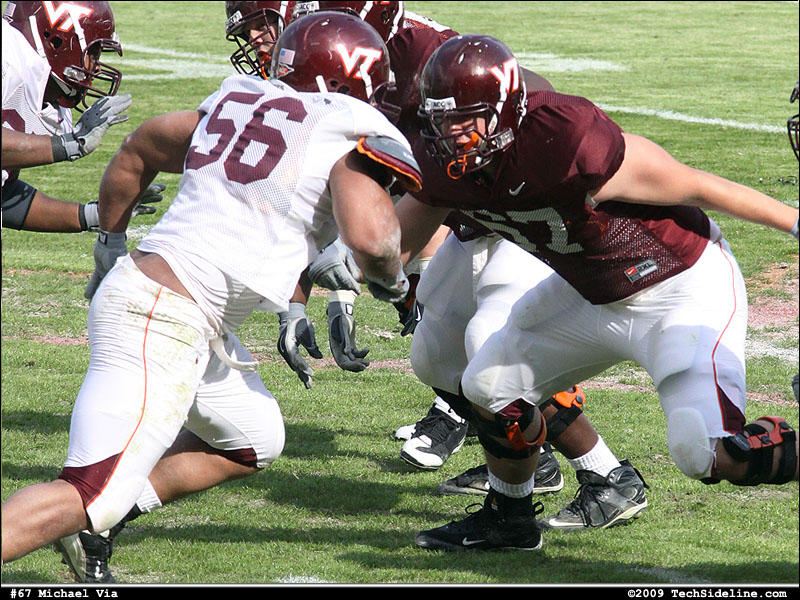
Since that time, there has been an adjustment made to the approach of recruiting
true offensive linemen - not just the numbers, but also the type of
athlete. There is a higher priority on athleticism and technique.
Gone are the days of the 350+ pound road graders. They still need to be
big and strong and have a true nasty streak, but there is a bigger emphasis on finding guys that can move their feet.
Given all of that, it should be easy to see that identifying and projecting
offensive linemen is one of the toughest recruiting challenges facing college
coaches. It's certainly true for the Tech coaches as they continue to
recover from a near disastrous situation just three years ago. As the
numbers slide up and down, there may be tactical adjustments needed on a year by
year basis to cast a bigger net and/or put the full court press on a couple
of offensive linemen that they really, really want to land. Bottom line is
that the situation three years ago is one that the coaches never want to face
again. The focus has increased and the early results are
encouraging. This year's line may be deeper than any Tech offensive line
this decade. The recruiting focus needs to continue to make sure it stays
that way for years to come.