

By the end of the 1993 football season, things were looking up for Virginia Tech Director of Athletics Dave Braine, football coach Frank Beamer, the Hokie football program, and the athletics department as a whole.
Braine's decision to keep Beamer as coach, despite pressure to release him, and his efforts to find funding to improve the football coaching staff, had paid off. The Hokies had gone 8-3 in the regular season and received a bid to the Independence Bowl, where they stomped Indiana 45-24.
1993 was VT's first full season in the newly-minted Big East Football Conference, in which Braine had engineered membership in late 1990.
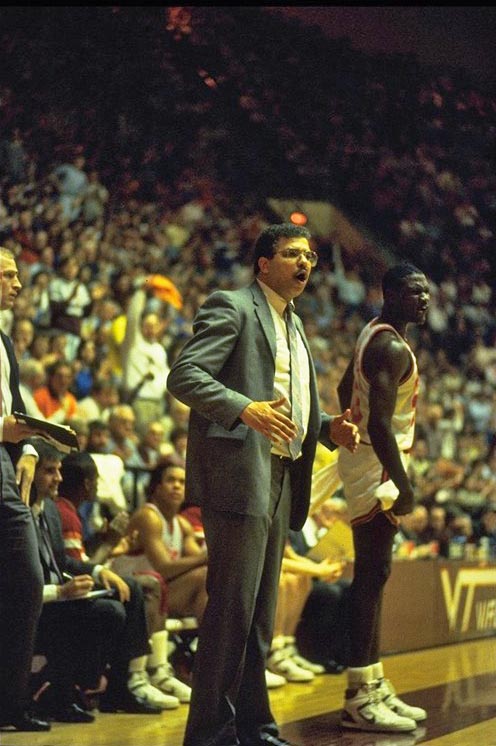
Things hadn't gone well in the basketball side of the house, however. Shortly after arriving at Virginia Tech in January of 1988, Braine had elevated interim head coach Frankie Allen to the full-time position, and Allen had been a miserable failure. The 1990-91 basketball season marked VT's third consecutive losing season, the first such streak since the 1950s, and attendance was steadily falling. Crowds averaged 5,888 in the 1990-91 season, the third-lowest since Cassell Coliseum opened in 1961. So Braine made the decision to fire Allen, and replace him with Bill Foster.
Meanwhile, buzz was building that the Hokies were going to be invited into the Big East, where they were a football-only member, for all sports. In early 1994, the Big East presidents appeared to be set to invite the four football-only schools -- VT, Temple, West Virginia, and Rutgers -- into the league for all sports. Barring that, the football schools in the conference -- which included BC, Syracuse, Miami, and Pittsburgh -- had plans to break away and form a new eight-team all-sports conference. The eight football schools had even gone so far as to draw up operating procedures for a new eight-team conference.
Everything fell through at the last minute. Not only did the four football-only schools not get invited into the league as a group, but the eight football schools didn't form their own conference. Instead, West Virginia and Rutgers were invited in, and Virginia Tech and Temple were rejected.
(The Big East rejection is covered in great detail in our 2004 series Conference Wars, in part 2.)
Around the same time period, the Metro Conference fell apart, and the Hokies sought refuge in the Atlantic 10, where they started membership in the fall of 1995. None of it was a result that Braine sought or wanted.
(Conference Wars part 3 covers the collapse of the Metro.)
In the summer of 1997, having accomplished many good things at Virginia Tech, Braine left to take the Director of Athletics job at Georgia Tech, marking the end of a mostly successful, decade-long tenure at VT.
In the second part of this two-part interview, we cover the latter years of Braine's time at Virginia Tech, his departure for Georgia Tech, and beyond.
Let's shift topics to basketball. What do you remember about the decision to fire Frankie Allen? Was it difficult for you?
No, it wasn't difficult because we weren't well-coached, we weren't playing well. Danny Monk was one of my assistants, and he was a big basketball guy. We statted and charted and everything for two years, and there weren't any positives that you could hang your hat on to say that we were making progress and getting better.
Jerry Green was a guy who we really wanted to hire. He ended up being the head coach at Tennessee. We felt like he was going to take the job, but he backed out. He was an assistant to Roy Williams at Kansas at the time.
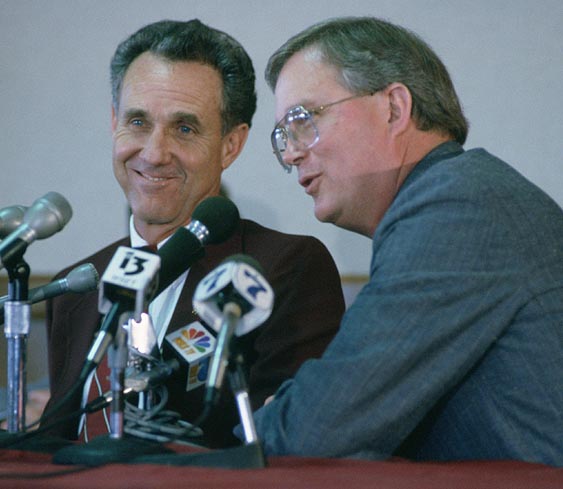
So we fell back to Bill Foster. He was out of coaching at the time. He had been out for a year. He had left Clemson and gone to Miami, and then got out. He wanted to get back in, and he ended up being a very, very good selection. He did a good job here.
Did you know Bill Foster would be relatively short term when you hired him?
We knew it would be three or four years, yes.
Did you know you were getting Bobby Hussey as his successor?
I was always a Bobby Hussey fan. When he was at Davidson and I was a Marshall, those schools were always playing against each other. They had the two best programs in the Southern Conference. When I hired Bill, no, I didn't have any idea that Bobby would end up coming here, but he did.
Was it a mistake hiring him? I don't think so, but again, different AD's, different things happen. Things change. I've never really delved into the fact that it didn't work out. I don't remember if the Hussey hire was the last hire I made, or the Bonnie Henrickson hire. Bonnie still gets on me for hiring her and then leaving her. So one worked out, and one didn't.
When it came time to choose Bill's replacement, was Bobby a "walk down the hall" hire, or did you really think about it?
Well, we didn't have coaches in waiting then, but we kind of felt like with Bill, Bobby, Dean Keener and the rest of the staff, there wasn't going to be much of a change. It just didn't work out that way. We basically didn't look at anyone else, no.
Let's talk about the 1994 Big East All-Sports rejection. After the rejection, it sounded as if you expected the eight football schools to break away on their own.
Yeah, and then there was a midnight decision made and nobody was going to tell us. We're down at Hattiesburg, Mississippi for I think the women's basketball tournament, and I got a phone call from Larry Keating, the AD at Seton Hall who I didn't know very well. He said "Dave, you don't know me very well, but I need to be honest with you and tell you that this thing isn't going to work out." None of the rest of the guys would tell me that, but he did.
He felt like people were leading us on, so he called. We still talk to this day. In fact, I had a long email with him within the last two or three months. He still remembers it very vividly. If the Big East had done what they should have done (editor's note: Braine means form an eight-team conference), they would still be going today. It was very interesting, what should have been done vs. what was done.
Why do you think it unfolded the way it did?
There was not enough support for Virginia Tech from the non-football playing schools.
When did the football schools lose their guts to tell the basketball schools "we're leaving"?
I don't know. I wasn't there. When you figure who they brought in, and who they didn't ... geographically, Miami should have never been in the Big East, but they were because they could control their own destiny. We were kind of the odd man out because of location again. Not only geography, but the fact that we didn't really fit in. Temple didn't get in just because people looked down their nose at Temple.
But I don't know. I just know that the Big East was one of the greatest highs and one of the greatest lows during my tenure. I've had some people tell me that that day in Hattiesburg I looked worse than any other time they saw me, so it obviously hurt.
The Metro Conference was obviously an eroding situation.
Well the Metro gave us an ultimatum. They basically told us that we had to come in for full membership [including a new football conference they were forming]. Of course we couldn't do that, and we ended up getting a million dollars from them and we joined the Atlantic 10.
I remember there was a lot of jockeying for position. The Metro wanted to move towards football and eventually form what was to be known as Conference USA. They eventually realized it would be easier to just kick out VCU and Virginia Tech. Did you smell that coming?
No, but we laughed when they did it. They were trying to tell us that we had to come into the conference in full membership and play football. We were already in the Big East Football Conference. It just didn't make sense. Dr. Torgersen - now you talk about somebody who was very sharp - when he was dealing with the people from that conference and the arbitrators ... not that I didn't have respect for him, but I really had a great deal of respect for him after that.
He is the only "academician" that walks both sides of the street, athletics and academics, and people respect him on both sides. I've never seen him ruffled, mad, or treat somebody differently, or raise his voice. He has a side to him about arbitration that most people don't know. Sitting in that room with him, dealing with those arbitrators from the conference, he was something special.
The success of the football program from 1993 through 1996, what was it like to see that vision come to fruition? After deciding to keep Frank, you hit it out of the park the next four years.
Yeah, but you know what? In the athletic world, it's never what you've done. It's "what are you going to do for me next?" That's just the way the business is. You can't sit on your laurels. If you do, somebody's passing you by.
Oh yeah, I'm proud to know that part of this foundation of the athletic program we built, but there were people like Coach Mosley and Stuart Cassell before me, they did an awful lot too.
I remember leaving the Sugar Bowl in 1995 and wondering if it would ever be that good again.
I'll never forget Bryan Still's punt return, and I'll never forget walking on the floor of the Superdome high-fiving all the fans with a minute to go in the game. That moment, the final two minutes of the first half of the Independence Bowl, and Travis Jackson's shot against New Mexico State are memories that will always be etched in my mind.
Then you left for Georgia Tech in 1997. When you left, you got a raise from $150,000 to $250,000.

That was on paper. I also had a radio and TV package that almost doubled that. For about four or five years running, I was the second-highest paid AD in the country. So the $100,000 raise was only part of it.
It was a decision that had to be made. You can look back on it, even knowing what Virginia Tech did later ... I was asked a thousand times in 1999 if I wished I was still at Virginia Tech. For what the move did for my family, it was still a no-brainer. We're back here [in Blacksburg] now, and we're living a good life, and we enjoy Blacksburg and our retirement. We wouldn't be able to do what we're doing now if we had stayed here.
Remember when I said you shouldn't take a job after someone who was successful? Well, in that situation Homer Rice had been the AD at Georgia Tech for 18 years [Rice was GT's AD from 1980 to 1997], and he had been very successful. He was so instrumental in bringing that program back. God Bless Coach Dodd [GT's AD from 1950-76], but when he was there things just ran downhill. Everything had been just run into the ground.
Homer was an outside guy. He could raise money. We were complete opposites. He was an outside guy that could do fund raising and build things. I've always been an inside guy. To me, the programs are for the kids. That's why you have the programs. You don't have an athletic department if it weren't for the kids. To this day, that's what it's all about.
In retrospect, even though he had been successful, the 10 years we were at Georgia Tech were the best 10 years they've ever had in winning, building programs and being successful. So you had a chance to be successful in another way.
But it also took its toll. I ended up getting sick and coming down with Crohn's Disease and having to retire. There's no clear cut answer to what causes Crohn's Disease, but I can tell you in my case that there's no doubt it was stress.
(Note: Though we did not include the specific quotes in this interview, Braine talked openly with us, and has talked openly with others in the past, about avoiding trips to the bathroom, "holding it in" and "losing what looked like a pint of blood" during bowel movements.)
You felt more stressed down there than you did at Virginia Tech?
Oh, I didn't have any stress here. Here we built, we continued to build and continued to be successful. People were happy with the program here. There [at Georgia Tech], only one or two people controlled everything, and if you didn't do what they wanted to do ... if you fought the powers that be, they could make life very difficult for you.
There were a couple of people who didn't like the fact that I hired Chan Gailey. They tried to make life very miserable. All Chan did was go to a bowl game every year.
If you had it to do over again, would you leave Virginia Tech? Knowing what you know now?
You know, I don't think I could have done what Jim Weaver has done here. Sometimes a change is good for everybody. I think the change was good for us, my family, but I think the change was also good for Virginia Tech. I think Jim Weaver has been unbelievably good for Virginia Tech.
I look at that stadium, and I look at some of the changes that have been made around here with facilities and everything, and I don't know whether I would have had the vision to do that, or whether I would have had the fire to do all that.
On the other hand, I went to Atlanta and we completely rebuild the football stadium. We completely rebuilt the baseball stadium. Their facilities are now better than they've ever been. So sometimes a change is good.
How much were you beating the drum for Virginia Tech during ACC expansion in 2003?
Well, it wasn't that way because Virginia Tech was never, ever part of it until right at the end. Virginia Tech didn't bring anything to the table. [Editor's note: Braine means that the ACC already had the state of Virginia in its geographic footprint, and adding VT wouldn't expand TV markets].
There was never any time spent on Virginia Tech. I'll never forget. If the decision was made on a Friday to bring in Virginia Tech, the Monday prior I get a call from Minnis Ridenour saying to me, in essence, "Dave, what can we do?" Because they knew they weren't getting in.
I said, "Minnis, the only thing I can tell you is that it's above you and it's above me."
Frank called, same thing. I said "Whatever you are going to do, you better do it now. And it's got to be from above." Meaning politically, whatever you can do. Obviously from that Monday to that Friday, there were a lot of phone calls and a lot of string pulling. Whatever happened between here and Richmond in that span ... obviously the governor came out and said nothing is happening unless Virginia Tech gets in.
It was a shock [that Virginia Tech got in]. It was never, ever, ever discussed with the AD's, other than in passing. It was going to be Syracuse.
So the Governor got involved, and I don't know if pressure is the right word ...
We don't know. I don't know. That was all above me. It was above my pay grade. I just know that on Monday it wasn't going to happen, and on Friday it happened.
Once the ACC took a harder look at Virginia Tech, when they showed up to evaluate the school and athletic department, I think they were very surprised by what they found.
Not only were they very surprised then, but when Virginia Tech won the first football championship, then they understood what people were trying to tell them about how good the program was. People had looked down their noses before that.
I'm going to tell you, there were several ... I mean, Duke wouldn't even talk about expansion. They wouldn't even come to the meetings.
I think once they showed up to look, they were surprised by things like the level of academic support ...
They were surprised by everything.
I think that's embodied by Bill Brill's statement that VT would never win an ACC Championship in any sport in his lifetime.
Bill Brill hated Virginia Tech. And if he was alive today and sitting right there, I'd say the same thing. He was so cruel to us the whole time I was here. Vindictive, almost. Just because somebody mistreated him once or twice, he held a grudge against Virginia Tech, I guess. I always heard that when he was a young buck reporter there were times that he wasn't treated well, and he always held that against Tech.
As you look back on your career, in what context do you place your career at Virginia Tech? Was it the most enjoyable? Most challenging? Did you accomplish the most? Is VT still your favorite place?
I look at all three places where I was AD ... I always live by the premise that I tell people when I hire them, that if you're only here for a year and you make the place better, then you've done your job. You've made it better for the next person. Hopefully we did that at all three schools.
This [VT] was the biggest challenge. And probably what we accomplished here I'm more proud of, because we had so many things to do. We love this place. That's why we're back here. That's why we live out in the mountains in the valley now. I will always be proud that I was the AD at Virginia Tech, and yes, Virginia Tech ... I'm a Hokie.