


A quarter century ago, Michael Vick lifted Virginia Tech football to new heights. Now he’s being honored by being voted into the College Football Hall of Fame.
The 44-year-old Vick was one of 18 players who will be inducted in 2025, the National Football Foundation announced Wednesday. It was the quarterback’s second year on the ballot.
He’s the ninth person with Virginia Tech ties to get the honor and follows in the footsteps of another key piece of the 1999 team that played for the national championship, defensive end Corey Moore, who was enshrined in 2023.
The other people with a Hokies connection in the club include Hunter Carpenter, Andy Gustafson, Carroll Dale, Frank Loria, Jerry Claiborne, Bruce Smith and Frank Beamer.
Eighteen players and four coaches, including Nick Saban and Urban Meyer, are in the 2025 class. They’ll be inducted during a ceremony in Las Vegas, Nev., on Dec. 9 at Bellagio Hotel & Casino.
Vick, a Newport News native and Warwick High product who was recently named the head coach at Norfolk State, only spent three years in Blacksburg, but he helped put it on the map with an electrifying dual-threat style that set the mold for future generations of quarterbacks.
Though the lefty’s numbers in two years as a starter look quaint by today’s standards — 3,074 passing yards and 20 TDs, with 1,202 rushing yards and 16 more scores on the ground — he was the driving force on a Hokies offense that was one of the best in the country at the turn of the century.
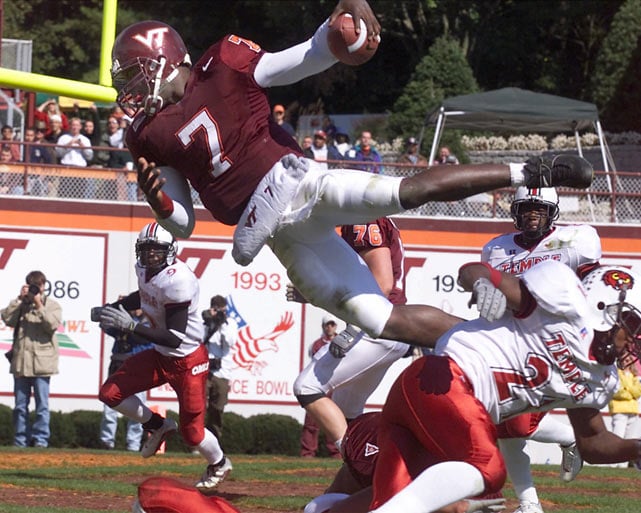
That introduction came in 1999 after a redshirt year, with Vick debuting his lightning-quick moves and cannon for an arm during an 11-0 regular season that ended with a Big East championship. Tech led the nation with a 41.4-point scoring average.
He ran by, around and occasionally over the competition in a scintillating freshman campaign, flipping head over heels — literally on one touchdown run — into the nation’s consciousness in his three-touchdown debut against James Madison. He later preserved Tech’s undefeated regular season with a sprint up the sideline in the final minute against West Virginia to set up Shayne Graham’s walk-off field goal.
Vick finished with the third-highest passing efficiency in history at the time (180.4) and won both the Archie Griffin Award as college football’s most valuable player and the Big East Offensive Player of the Year. He was a first-team All-America selection by the Sporting News, a designation that made him eligible for Hall of Fame consideration.
He earned an invitation to the Heisman Trophy ceremony, finishing third behind Wisconsin’s Ron Dayne and Georgia Tech’s Joe Hamilton. It was matched the highest-ever finish for a freshman in the balloting, tying Herschel Walker in 1980.
Vick’s efforts helped the Hokies clinch a spot in the Sugar Bowl for the national championship against Florida State. Though Tech lost the game 46-29, the freshman stole the show, throwing for 225 yards and a touchdown and running through a Seminoles defense littered with NFL talent for 145 yards before accounting for 48 yards in sacks.

He had a similar sophomore campaign, leading the Hokies to another 11-1 record, with their only loss being a 41-21 setback at Miami when Vick was limited to only 19 first-half plays due to an ankle injury.
Vick finished 20-1 at Tech as a starter with the Hokies, concluding his career with an MVP performance in a 41-20 win against Clemson in the 2001 Gator Bowl. He declared for the NFL Draft 10 days later, setting him on the path to be selected first overall by the Atlanta Falcons.
Though his NFL run was interrupted by a conviction on federal charges related to his involvement in a dog-fighting ring in Newport News, with Vick serving an 18-month sentence in prison, he resumed his career following his release and served as an advocate against animal cruelty.
Vick won NFL Comeback Player of the Year with the Eagles in 2010, making the Pro Bowl for the fourth time. He last played in 2015 and formally retired in 2017, concluding a 13-year career with the Falcons, Eagles, Jets and Steelers and finishing with 22,464 passing yards and 133 touchdowns. His 6,109 rushing yards stood as a record for a quarterback until Lamar Jackson moved past the mark this year.

A presence on the Virginia Tech sideline over the years, Vick stayed connected with football in retirement, serving as an NFL analyst on Fox’s pre-game show starting in 2017.
Last month, he jumped into coaching, hired by Norfolk State to lead the HBCU program, following a similar path of other College Football Hall of Famers Deion Sanders (Jackson State) and Eddie George (Tennessee State).