

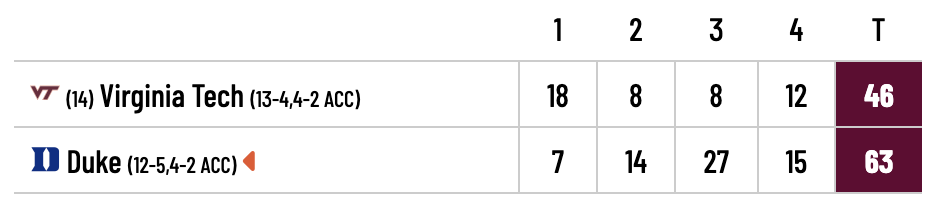
DURHAM, N.C. — What started out as a good Thursday night quickly turned into a bad one for No. 14 Virginia Tech in its 63-46 loss at Duke.
The Hokies (13-4, 4-2 ACC) led 18-7 after the first quarter but were outscored 56-28 the rest of the way. They struggled to do anything in the second half and were held below 50 points for the first time since Jan. 2022 at NC State. It’s also its first time losing two consecutive games since the end of the 2021-22 season.
“The complexion of the game,” said Tech head coach Kenny Brooks about what changed after the first 10 minutes. “They got extremely physical and if you’re allowed to play that way, kudos to them, but just a physical game.”
After Tech got off to a roaring start, the Blue Devils (12-5, 4-2) cut into the deficit and made it a five-point game at the break. They came out of halftime on fire, too, and scored the first eight points of the second half to take the lead, which it never relinquished.
Duke outscored Tech 27-8 in a lopsided third quarter — the 19-point deficit is Tech’s worst period of basketball since the it was outscored by 19, 28-9, at Virginia in Jan. 2019 — that completely flipped the game on its head.
The Hokies appeared to be barely holding on at that point, frustrated by Duke’s pressure, and an injury to All-American point guard Georgia Amoore felt like the final blow. With 6:36 remaining in the period, she dove for a loose ball, was elbowed in the head and was slow to get up. Team trainer Erin Cash helped her to the locker room, and she did not return. Brooks did not have an update after the game.
It was three-point game when she left; Duke outscored Tech 34-18 afterwards. Her departure compounded things and the team’s lack of depth at that spot showed. Elizabeth Kitley, who led the team with 18 points and 10 rebounds, scored on an out-of-bounds play once play restarted, but when Tech got back into running its set offense, it turned the ball over on three consecutive possessions.
The Hokies were 4-of-16 over the remaining 16-plus minutes with eight turnovers. For the game, they finished with 20, 13 of which came between the second and third periods.
That played right into Duke’s hands. A scrappy, physical team that likes to turn teams over and get out in transition, the Blue Devils took some time to find their rhythm, but once they did, Virginia Tech didn’t have an answer. They outscored Tech 19-0 on the break and 30-14 in the paint.
“I just felt like if we could grab ahold of the game a little bit, if we could get some stops…” Duke head coach Kara Lawson said. “And then the stops allow you to run. That’s what’s important for us. If we can get stops, we can get out and run. … And I think we’re at our best when we’re playing with great pace.”
Reigan Richardson was the best player on the floor and led Duke with 22 points (10-of-15), three steals, two rebounds and two assists. Ashlon Jackson joined her in double figures with 13 and played a crucial role — she had all eight of Duke’s points in the 8-0 run at the start of the second half that opened the floodgates.
While Tech didn’t fare well in the second, third and fourth, Duke flourished, making 22-of-45 shots (49%). Brooks opted to switch to a 2-3 zone in certain spots, but it didn’t work. In the middle two periods, the Blue Devils only had two moments where they missed two field goals in a row while attempting 28.
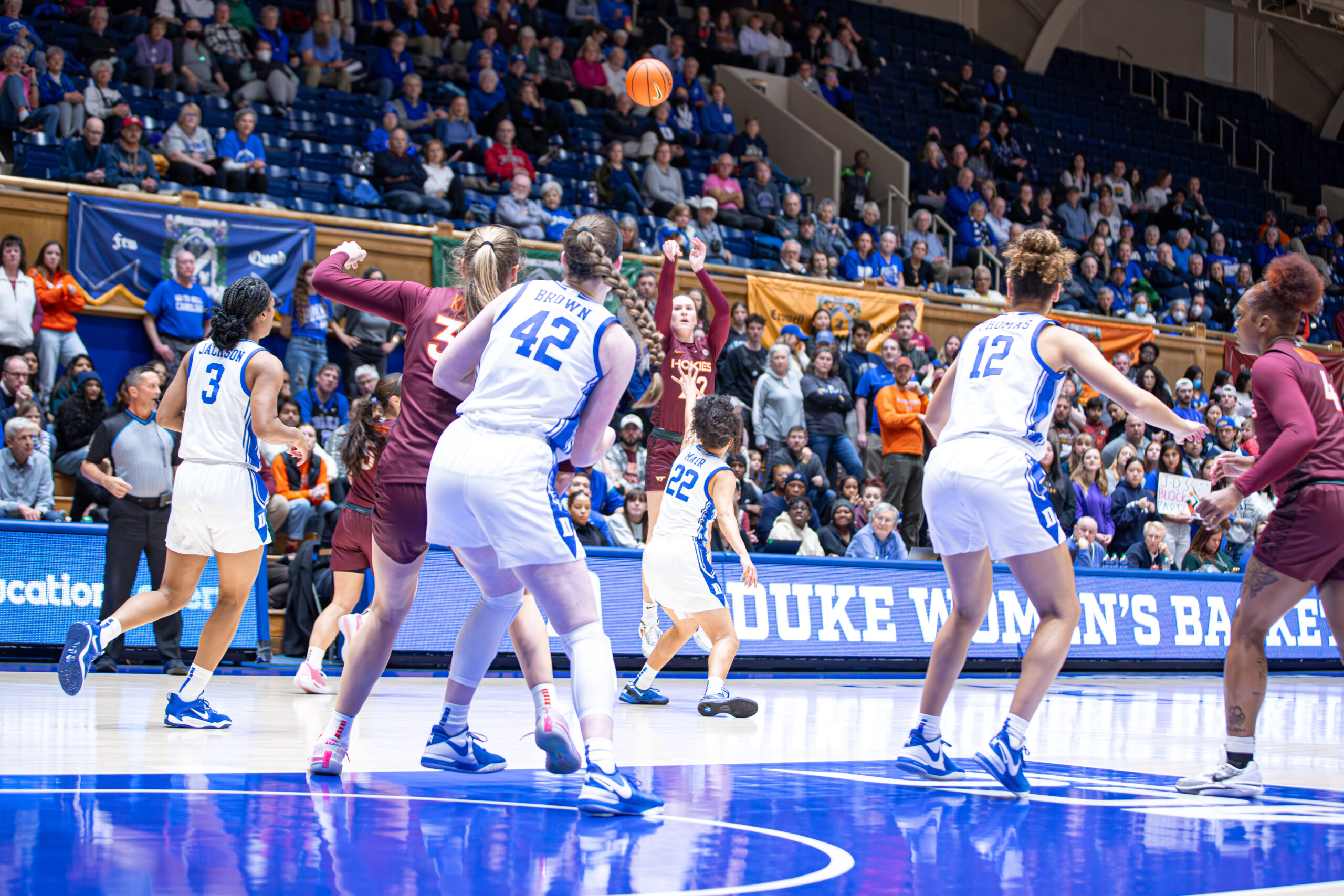
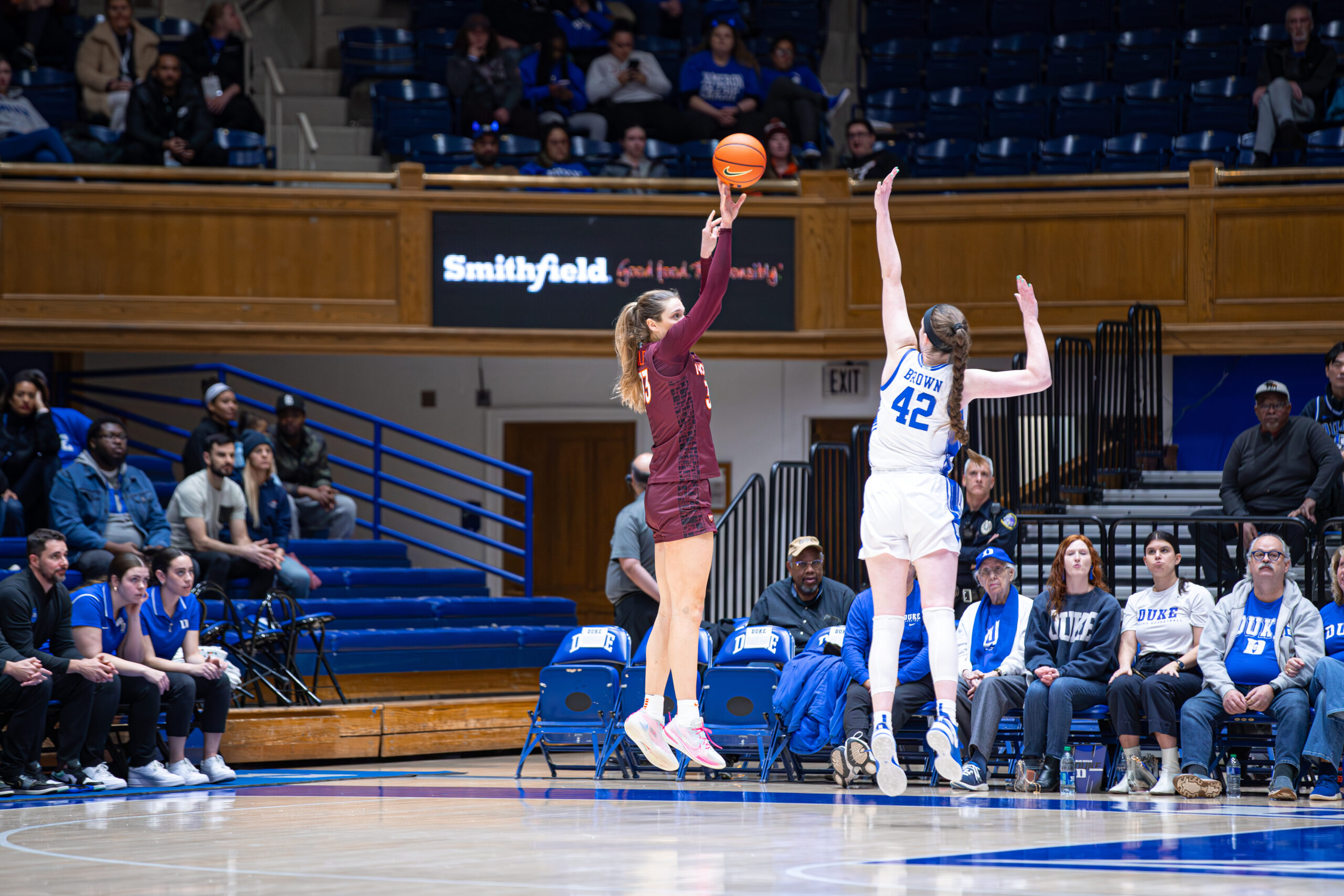
The more Duke settled, the more rattled Tech became. It made four 3-pointers early — two from Amoore (six points), two from Cayla King (nine) — but was 1-of-12 over the final three periods. Even Kitley, who was 6-of-7 in the first half with 12 points, had a tough time after intermission. She was 3-of-11 in the second.
The way the game flowed had something to do with the inefficiencies too. The Blue Devils were more physical and energetic across the board than Tech but weren’t restricted. They shot 12 free throws to Tech’s 14, but the Hokies only attempted four in the first three quarters; in the fourth, they took 10. Duke was whistled for more fouls when the game was out of hand in down the stretch (nine) than the other three quarters combined (eight).
The Blue Devils were able to play their preferred style and Virginia Tech, no matter if Amoore played or not, could not match it for a variety of reasons.
“They took advantage of the way the game was going. Much credit to them. They took advantage of it,” Brooks said.
Brooks opted to roll with different lineups late and gave some time to freshmen Carleigh Wenzel, Carys Baker, Samyha Suffren and Clara Strack. Suffren had nine points, five of which came at the line, but as a whole, the group didn’t do much besides turn it over. The lone “bright spot,” if there was one, was Suffren, who drew six fouls in 17 minutes from attacking the basket. Brooks said she can help going forward.
Other than that, however, it was a bad performance. Losing Amoore for an undetermined amount of time is a nightmare scenario, and though the team has talent, it looked lost on both ends for long stretches of Thursday’s game in Cameron Indoor Stadium. Duke is a great defensive team that denies everything and frustrating to play against — Tech lost in Durham last season, too, and is 3-16 all-time there — but the Hokies struggled to even set up some halfcourt sets. Nothing came easy, as expected on the road in the ACC.
With 12 regular-season games remaining, Tech now has an opportunity to look in the mirror and reflect. It hosts Clemson (Sunday) and Georgia Tech (Thursday) before going back on the road on Jan. 28 to Syracuse, two chances to rally and right the ship in front of the home fans.
“You run into a game like this and that’s the complexion of the game, you have to learn how to adjust,” Brooks said. “That is on me. … But there’s a lot of basketball left. To win on the road… we were here last year and the same thing happened. We’ll go back and we’ll prepare. You just have to adjust, but this league is so tough, especially to win on the road. You can’t allow a game like this to discredit what you’ve done or who you are.”
Box Score: Duke 63, No. 14 Virginia Tech 46