

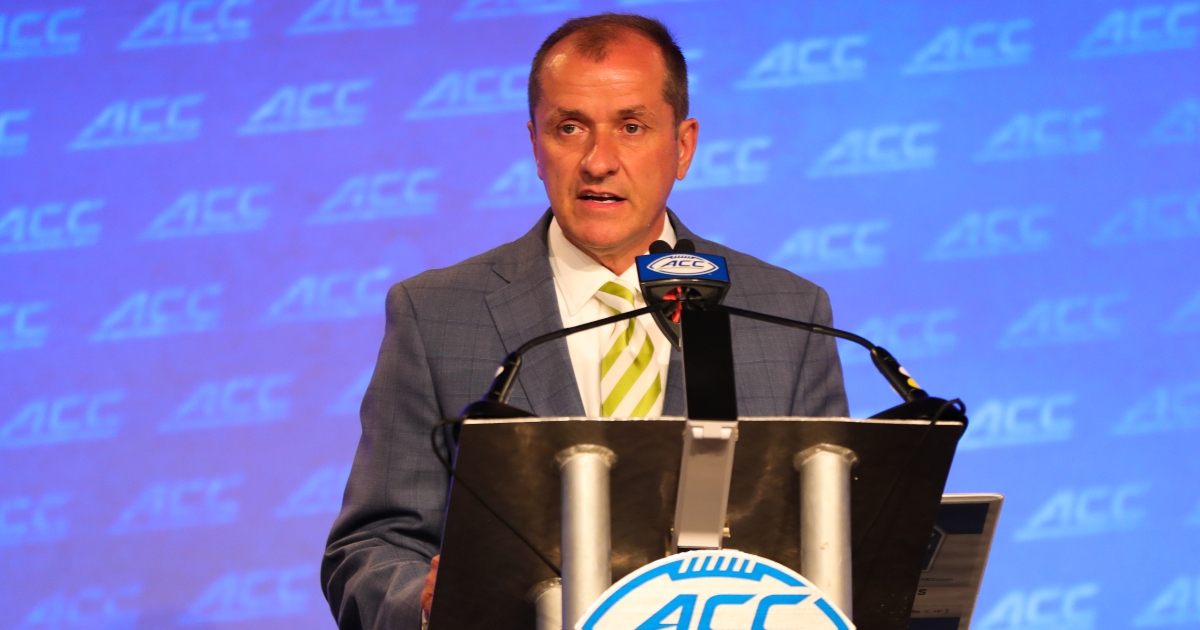
At the ACC Football Kickoff on Wednesday in Charlotte, conference commissioner Jim Phillips repeated variations of the phrase, “all options are on the table.”
The context included strengthening the Atlantic Coast Conference via expansion, media rights discussions with ESPN and potentially changing the league’s revenue distribution formula.
With Oklahoma and Texas joining the SEC in 2025 and the recent seismic shift involving UCLA and USC to the Big Ten in 2024, college athletics appears to be on a path to a “power two” landscape. Projections show the Big Ten could distribute close to $100 million in media rights per school when its new deal is signed. Meanwhile, the ACC is still lagging behind — $36.1 million was each university’s payout in 2020-21.
Amid realignment, the ACC’s grant-of-rights deal is holding the conference together, but also back at the same time. It runs through 2035-36 and essentially says that if a school jumps ship for another league, its television revenue still goes to the ACC. The Pac-12 and Big 12 have similar agreements, but both expire in the next three years, which is what allowed moves from Texas, Oklahoma, UCLA and USC.
Back in 2016, then-ACC commissioner John Swofford signed over the league’s media rights for the next 20 years. So far, the document has kept the conference together. But if the opportunity presented itself, would anyone dare test those murky waters in search of a better future?
“I would think that the significance of what that would mean, the television rights that the conference owns as well as a nine-figure financial penalty, I think it holds, but your guess is as good as mine,” Phillips said. “I love our 15 schools, and I'm confident in us staying together. That's all I've heard in all the calls that we've had.”
Phillips admitted that the ACC is a leader in many areas “except the revenue piece of it.” The Big Ten’s recent move just sheds more light on that. So, assuming it's possible, how might the league add value?
Notre Dame jumps to mind. Phillips knows the Irish well — he worked for the university as the senior associate director of athletics for external affairs from 2000-04. If they wanted to join a conference, would they consider the ACC, or would ties to Michigan, USC and a Midwest-centered Big Ten be more appealing?
“They know how we feel,” Phillips said of Notre Dame. “They know that we would love to have them as a football member in the conference, but we also, and I also, respect their independence. … I know that if there comes a time that Notre Dame would consider moving to a conference and away from independence, I feel really good about it being the ACC.”
Another option was mentioned by colleague David Teel on Wednesday: the ACC adjusting its revenue distribution formula. Could league members with higher performance and brand value be rewarded with a larger chunk of the pie?
One glimpse at the 2022 LEARFIELD Directors’ Cup standings might suggest that North Carolina (No. 6), Virginia (No. 11) and Florida State (No. 14) deserve more of a share than Boston College (No. 109), Pitt (No. 73) and Syracuse (No. 72).
“I would go back to what I said earlier and answered: all options are on the table,” Phillips remarked. “When you look at revenue, you look at closing the gap, you look at generating more, you look at distribution, it all is part of a similar conversation.”
Phillips made it clear that while the presidents and athletic directors in the ACC are open to change if it can close the gap, it can’t come at the expense of other things the conference is currently doing. Either way, the SEC and Big Ten are distancing themselves from the rest of the field.
The ACC continues to lean on its academics and education. As the commissioner referenced, the league has led the FBS conferences in best college rankings by U.S. News and World Report for 15 straight years. But when it comes to generating revenue and competing for national championships in football, the ACC is falling quickly falling behind with no real way to draw closer. The marketability of the conference’s members just doesn’t compare, even against the Big Ten, where all but one university (Nebraska) is an AAU member (Association of American Universities).
“We are not the professional ranks,” Phillips said. “This is not the NFL or NBA-lite. We all remain competitive with one another, but this is not and should not be a winner-take-all or a zero-sum structure. College athletics has never been elitist or singularly commercial.
“I will continue to do what's in the best interest of the ACC but will also strongly advocate for college athletics to be a healthy neighborhood, not two or three gated communities.”
Phillips might not want it that way, but that seems to be the trajectory for which the SEC and Big Ten are headed. SEC commissioner Greg Sankey called his conference a “super league” on Monday, and those two giants know where they stand.
It’s like a chess game where checkmate seems inevitable. All options might be on the table, but the ACC’s destiny seems to be already written — a second-tier conference that is miles behind the two leaders.