

This morning, Virginia Tech announced a new $400 million Reach for Excellence campaign for the athletic department that is based on five pillars: the football program, Cassell Coliseum renovations, the Drive for 25, the scholarship endowment, and all other sports. This article is going to focus on the football side of things and how I think the fan base needs to respond for the athletic department and football program to truly match their potential.
Rather than sitting around and doing what has become a bad habit over the years – talking about what the Hokie Club and the powers that be at Virginia Tech haven’t done – let’s talk about what they have done.
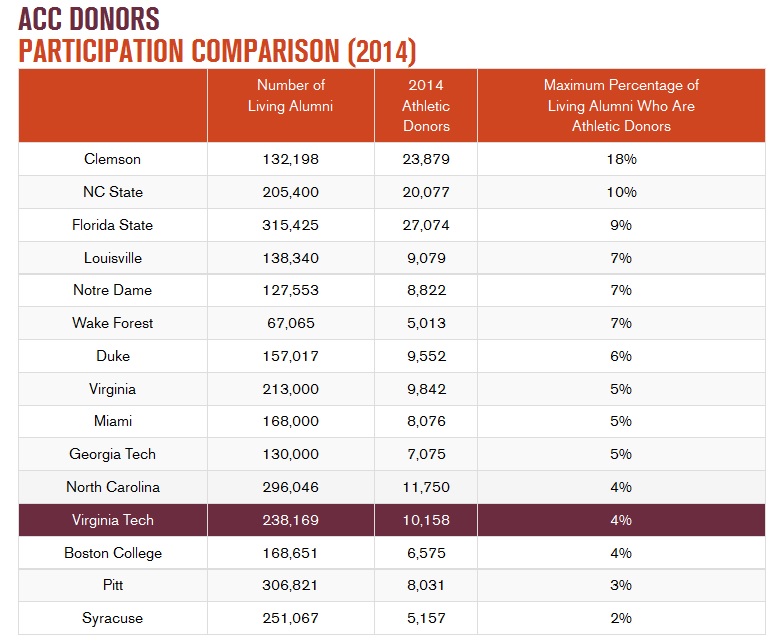
In 2016, when the Drive for 25 was first announced, it was pointed out that as of 2014 only 4% of Tech graduates were members of the Hokie Club. The actual number was less than that, because some people who donate aren't Tech grads. The graphic below was a big part of the narrative in late 2016/early 2017, but it was forgotten as time went on.
By 2017-18, that percentage had risen to 5.6%.
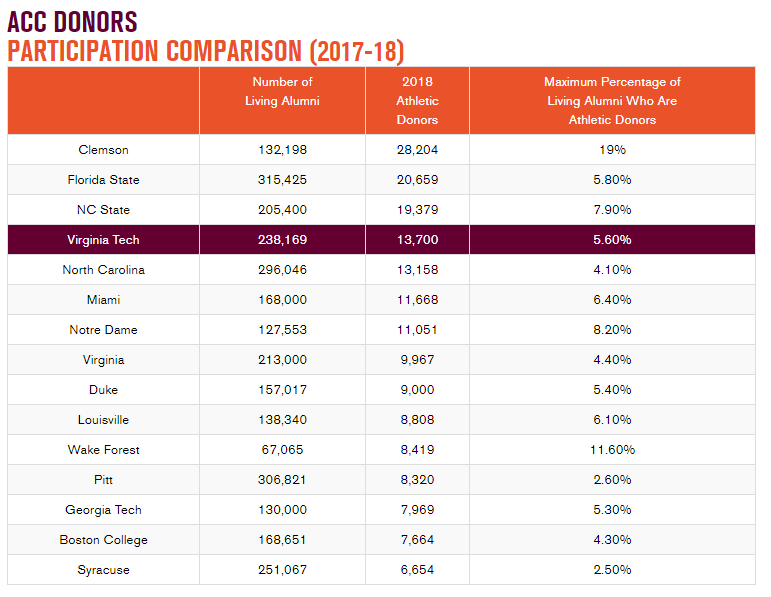
The latest graphics from Virginia Tech show how that number has continued to steadily increased through time.

Hokie Club membership now stands at 7.66% of living alumni, which is the fourth-highest percentage in the ACC, behind Clemson, Wake Forest and Georgia Tech. Overall Hokie Club membership has nearly doubled since the launch of the Drive for 25 campaign, so it’s not like the Hokie Club and the powers that be have been sitting around doing nothing. They have steadily grown the donor base, and even if many of those new donors are joining at the lowest level (say $100 per year), as time goes by and those people accumulate more wealth, a $100 donation could easily grow into a $10,000 donation or even more.
In a way, I think we as a fan base (and I include myself in this) have grown to be pre-conditioned to complain. When something positive is announced, we tend to nitpick it until we find something that we can construe as negative, as if the perfect solution to everything can be found. If it’s not exactly like we want it, we criticize it, the negative vibes build up, and the negative reactions are even greater for the next announcement. It's a big snowball rolling downhill. Negativity breeds negativity. It’s common for fans to say the Hokie Club has done nothing, but the numbers show that they clearly have done something.

That has to end. If that sounds like I’m calling you out, I am, but don’t take it as disrespect. I’m calling myself out, too, and if I stray from what I’m about to say I want you to call me out on it. It’s time to forget about missed opportunities from yesteryear and what Virginia Tech Athletics and the Hokie Club have or haven’t done in the past and focus on what they are trying to do in the future. What’s the point of complaining about the past? It doesn’t help anybody going forward, and all it does is create more of those negative vibes. I’m not telling you how you should feel, but I am saying that it’s very important that the fan base pull together and buy in to the plan announced this morning.
The only way to have success is to move forward united and together. I remember back in the day when it was common for Virginia Tech fans to say that Hokie fans were the best in the country. In terms of traveling to road games and bowl games, jumping to Enter Sandman and making Lane Stadium a great home field atmosphere, you could hardly argue with them. Now the fan base has a new challenge, and I hope we collectively accept it.
When Clemson asked their fan base to buy in, they did. Over 18% of Clemson’s living alums donate to their athletic department, and it’s that financial windfall that allowed Dabo Swinney to hire the best coaches in the country, assemble an army of staff members for recruiting and player development, upgrade their facilities to the top level, etc. Dabo wasn’t an overnight success. It was only nine years ago that the Tigers lost to West Virginia 70-33 in the Orange Bowl, and that came a year after Swinney went 6-7 during the 2010 season. He wasn’t a great coach until his program began receiving great amounts of money.
In 2010, Clemson reported $14.9 million in donations, and the next year that number dropped to $14.1 million. Now they pull in over $40 million each year.
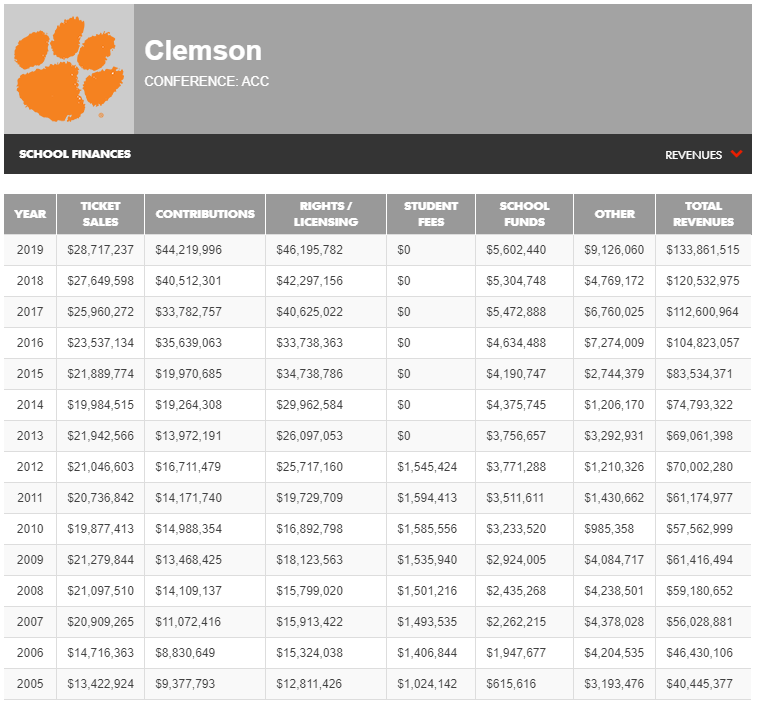
Virginia Tech was at $16.1 million in 2010, which was over $1 million more than Clemson. However, in Fiscal Year 2019, that number was at $18.9 million…about $25 million less than the Tigers. That’s how much things have changed over the last 10 years, and that’s the main reason both football programs have gone in opposite directions.
All the information is there. We know how the big programs find success. We know how much money they spend, and we know it’s a lot more than Virginia Tech. We know that, for example, schools in North Carolina can count out-of-state student-athletes as in-state students, which saves them a lot of money in scholarship bills, money that they can then divert to other areas of their programs that are in need. We know that UNC has $240 million in athletic scholarship endowments, compared to Virginia Tech’s $70 million endowment, and that itself is a significant disadvantage.
In short, we know what we need to do to move forward, and that’s make a financial commitment, just like we did a little over 20 years ago when the program was at a similar crossroads. Here’s a quick history lesson for those of you who don’t go back this far or may have forgotten.
Back in late 2000, Frank Beamer nearly left for UNC, and he was going to take his entire coaching staff with him. Yes, Frank Beamer and Bud Foster almost wore Baby Blue. Can you imagine? It almost happened. Ultimately he decided to stay, and shortly after that announcement was made, Virginia Tech’s coaching staff received raises and became the third-highest paid coaching staff in the country. The Hokies were able to retain elite assistant coaches like Bud Foster and Jim Cavanaugh because of the monetary investment into the football program. Can you imagine the history of Virginia Tech football if Bud Foster had been poached? Can you imagine a world where players like Bryan Randall, Xavier Adibi and Tyrod Taylor didn’t play for Virginia Tech, but instead went to North Carolina? That may not have happened if Virginia Tech didn’t dedicate the financial resources to prevent big programs from hiring away Jim Cavanaugh, the Hokies’ ace recruiter.
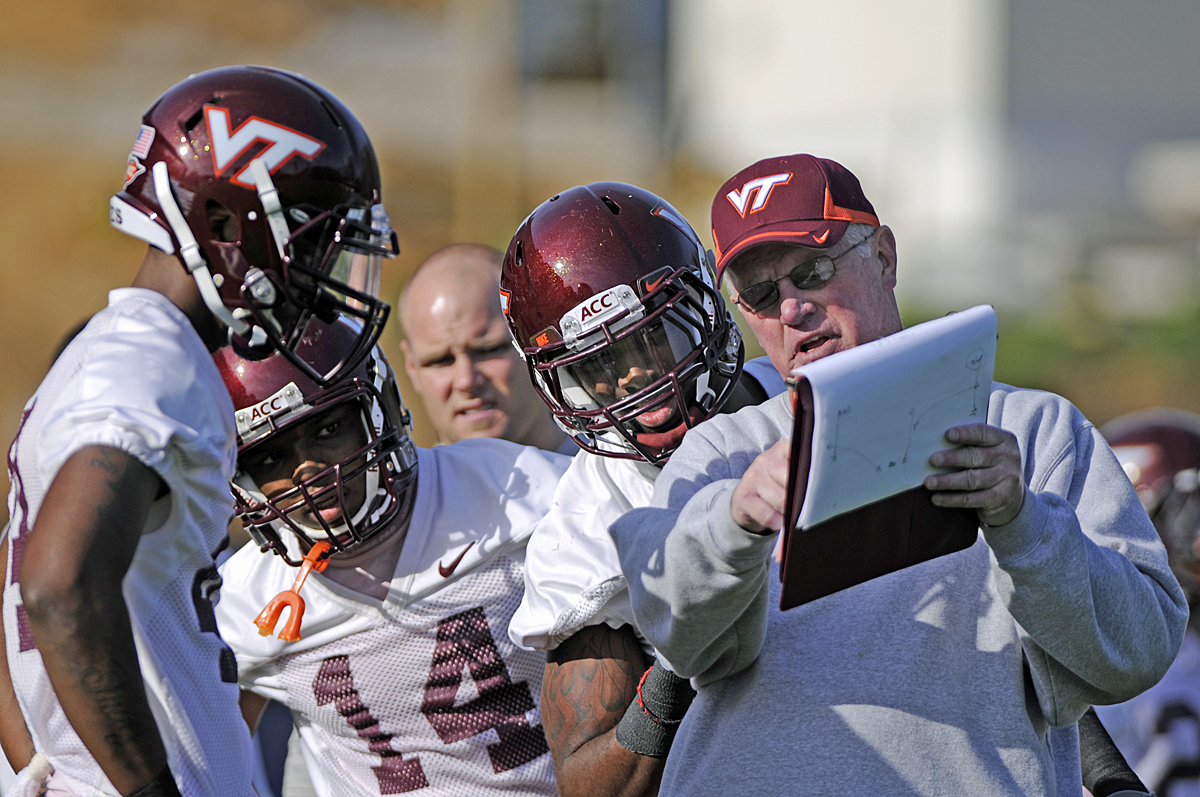
There’s a false narrative that has permeated the fan base over the years that Virginia Tech football, at its peak, achieved more with less. That’s not true. With the third-highest paid coaching staff in the country, Tech could afford to keep elite coaches like Foster and Cavanaugh (and Beamer himself), not to mention strength and conditioning coach Mike Gentry, and at the time the Merryman Center was one of the newest and most modern facilities in the country.
Virginia Tech dedicated more resources to the football program than their competition, and the results on the field followed. As great a head coach as Frank Beamer was, he’d be the first to tell you that having people like Foster, Cavanaugh and Gentry made a world of difference. The main difference between the program now and then is that now the Hokies couldn’t afford to hire those three guys if they were on the open market these days. Football has always been a bidding war to a certain extent…only now the amounts of money are much larger, especially in the SEC and Big Ten.
Virginia Tech’s announcement this morning of the Football Enhancement Fund is not new to your ears, if you’re a TSL Pass subscriber. We’ve been talking about it for the better part of a year. It was supposed to be announced the week of the Spring Game last year, but COVID shot that down. However, the Hokies have been able to improve and fine tune the plan over the last year, and basically it’s not any different than the demands that most head coaches make when they take a new job these days. These next five points are a direct copy and paste from Virginia Tech’s Reach For Excellence site:
- Recruiting: Student-athletes sign with coaches, not schools. Yet some ACC peers have three times more recruiting positions than we do. Dollar goal: $5 million
- Assistant coach salary pool: We need to provide competitive compensation for our coaches so that we can continue developing - and retaining - the best talent. Dollar goal: $10 million
- Quality control coaches: These coaches are preparing to take the next step as full-time, on-the-field coaches. Dollar goal: $5 million
- Student-athlete development: Our football student-athletes need dedicated support to prepare them for the real world. Dollar goal: $2 million
- Capital needs: We have immediate needs in our facilities. The first impression for visiting recruits must be improved. Dollar goal: $8 million
When Greg Schiano took the Rutgers job after the 2019 season, he demanded $7.7 million for his coaching/support staff, the use of a private plane for recruiting, a new football operations facility, a new indoor practice facility, infrastructure improvements, etc. I suppose the main difference between Virginia Tech’s transition from Frank Beamer to Justin Fuente and other coaching changes these days is that Fuente did not demand those things from Whit Babcock when he was hired. He’s probably kicking himself that he didn’t, because he’s now in a situation where his resources are not up to par with most of the competition, and that’s a situation that no head coach wants to find himself in. That’s now being fixed, thanks in part probably to Fuente’s flirtation with Baylor last year. I think that kicked the project into high gear. For further reading on that subject, click here to read A Shot Across The Bow from January of 2020.

That said, it’s important to remember that you don’t just snap your fingers and produce that type of money. This is a long-term play, from now through 2027. $150 million of the $400 million has already been raised, but there is still $250 million to go. Fuente may or may not be the long-term beneficiary of the Reach For Excellence campaign, but whether he is or isn’t doesn’t matter. Whoever is coaching Virginia Tech football needs adequate resources, whether it’s Fuente, Beamer, or a future head coach. These days, any prospective new head coach would demand them. If the Hokies changed head coaches tomorrow, without those resources the fan base would likely still be complaining about results five years from now.
Here’s what I wrote in A Shot Across The Bow last year, and I still believe it to be true…
“It’s not 2003 anymore, and I think some fans still believe it is. It has to be a group effort, starting with the administration, and then the fans have to buy in. If either of those two things fail, then we’ll be doomed to eternal mediocrity…or worse.”
The first step has to be the administration, and they took that step this morning. They stated their financial and competitive goals, and they detailed how the extra money would be used. Now it’s our turn, as a fan base, to buy in.
When Virginia Tech players run out of the tunnel onto Worsham Field, they reach up and touch the Hokie Stone that says: “For those who have passed, and for those yet to come, reach for excellence.” That applies to players and coaches on gameday, offseason workouts, etc. But to me, it’s something deeper than that. Those words apply to the fan base as well. How can we ask the players and coaches to reach for excellence, yet not also reach for excellence on our own behalf in terms of financial support? These days a top football program is a combination of fans, coaches and players, but the fans are what is most important. Players and coaches come and go, but the fans remain.
This campaign is appropriately named. We all want the players and coaches to reach for excellence each and every day, but for them to reach their ceiling, we as a fan base must also buy in and reach for excellence. Players and coaches compete with Clemson and North Carolina on the field, and it’s our job to compete with Clemson and North Carolina off the field in terms of financial support. If we don’t match them off the field, or at least come close, it will be extremely difficult if not impossible to match them on the field.
The torch has been passed from the administration to the fans. The information is there. The goals have been stated. The challenge has been laid down. At this point, it’s our responsibility as a fan base. Coaches come and go. So do players and athletic directors. It’s the fans who provide the foundation of the program and athletic department. We are the bedrock. Not Whit Babcock, not Justin Fuente, or Michael Vick, or even Frank Beamer. It is we who determine the direction we want the program to go, not anybody else.
Less than a decade ago, Clemson asked their fans to help, they did, and we see what happened. This morning, Virginia Tech asked for the help of its fan base. Will the fan base buy in as the Clemson fans did? Will we buy in, or will we deflect the blame to the people who can't succeed without our help? How good of a football program do we, the fans, want? The next six years will give us that answer.