

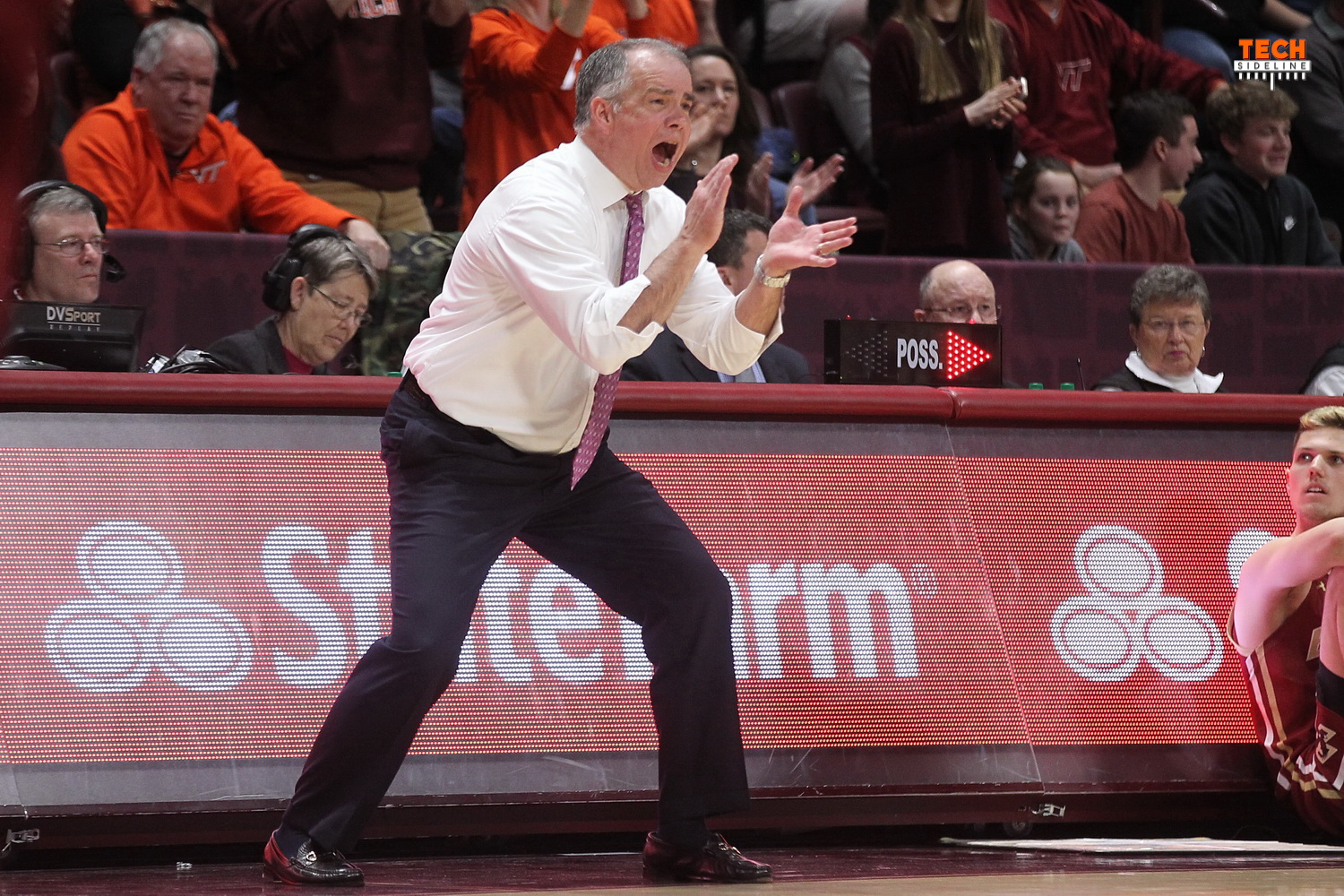
When looking at last season’s Virginia Tech Men’s Basketball team, there are two things that stand out: lack of experience and lack of height. As the offseason has gotten into full swing, the Hokies have taken steps to address both of those things with additions to the frontcourt.
“I do feel so much better about the health of that roster going into year two than I did in year one. Knock on wood, we were an injury away from being in a horrific state,” said Mike Young, head coach. “Just lucky as all get out playing PJ Horne, 30, 32, 33 minutes per game. We caught a major break in that regard. We had to adjust our practices because of our lack of depth on the frontline.”
Last year, the Hokies’ frontcourt was extremely limited. P.J. Horne was the starting center in almost every game at just 6-foot-6. Outside of Horne, freshman John Ojiako was the only real option to play down low off the bench. Tech’s leading rebounder was Tyrece Radford, the 6-foot-1 guard. With almost no depth in the frontcourt, the Hokies struggled against ACC opponents with size.
Just look back to the last game that the Hokies played in the ACC Tournament down in Greensboro. North Carolina had a dominant frontcourt with Armando Bacot and Garrison Brooks. The two combined for 32 points down low and seemed to score with ease against the much smaller Hokies. That should change as the Hokies have looked to add size this offseason.
“We’re going to get bigger and stronger. Some of the things we tried to do, we just got knocked out of because we’re playing so many young ones,” Young said. “That’s going to improve markedly next year.”
Not only could the Hokies not play the way that Young wanted to, but they also didn’t have the bodies to practice his way. With added size, the team should be able to add physicality to practice that they didn’t have before.
“We had to adjust our practices because of our lack of depth on the frontline. To get back to practicing the way I want to practice with the competition, you have to have competition in your practices,” Young said. “I didn’t feel like we had the competition that was healthy for a team this past year that we should have an abundance of as we look ahead to next season.”
Ojiako was the tallest player on the Hokies’ roster last season, but wasn’t able to translate his 6-foot-10 frame into early production during his freshman year. Despite flashes of his potential, he showed how raw he was on both ends of the floor.
“In my 18 years of coaching, I have never redshirted someone and regretted it. I think that’s such an incredible opportunity to grow physically and get a better understanding of the game,” Young said. “John Ojiako would have been an ideal candidate to sit a year ago, but we just couldn’t do it.”
With a year under his belt, Ojiako should step into a much bigger role. He still will be the tallest player on the roster and will be adjusted to the college game. His sophomore year should be an opportunity for him to grow from a role player into an everyday starter.
Something that will help him is having other options down low. Horne will be back for his senior year, but won’t be the only option alongside Ojiako. The main addition down low is Wofford transfer Keve Aluma. After sitting out a year following his transfer, Aluma is finally ready to return to the floor for Young. The 6-foot-8 redshirt junior power forward immediately adds a starting level big man that the Hokies so desperately needed last season.
“I love his game and he was really good for us in practice this past year. Chester Frazier, if I heard him say it once, I heard him say it 50 times, ‘He would make us so much better right now,’” Young said. “He had a year in the smokehouse as I refer to it, and he will be better because of that experience. Really excited about what he’ll bring to our roster.”
It looks like Aluma along with last year’s group of Ojiako and Horne will be the main contributors on the block for Tech. However, two newcomers will certainly challenge for playing time.
Adding more experience, Iowa grad transfer Cordell Pemsl will be another role player in the mix for serious minutes off the bench. Pemsl has played in Cassell Coliseum before and cleaned the boards for 14 rebounds, including seven on the offensive end, when the Hawkeyes traveled to Blacksburg in 2017. He started 14 games as a freshman, but took a backseat over the last few years, leading him to transfer for his final season.
Finally, Tech added another young piece to the mix with the late signing of David N’Guessan. The freshman was ranked as the sixth best player out of Maryland by 247 Sports in the 2020 class and had offers from DePaul, VCU and Washington State.
“David is just a bouncy, athletic young person who can really shoot the ball,” Young said. “He has some three in him at 6-9, 6-10, but we’ll start him at the four early on and just give us a chance to get longer.”
Last season, the Hokies had just two players at 6-foot-8 or taller on the roster with Ojiako and grad transfer Branden Johnson, who rarely received minutes. The Hokies now have four players at 6-foot-8 or larger who should all receive significant minutes this season. Tech has more size this year than they have had in a very long time, which will bode well for progress in the Mike Young era of Virginia Tech basketball.
“We had to manufacture quite a bit on last year’s team, but I do think this coming year’s team will have better opportunities to pull up on one or two dribbles and get the ball into the paint,” Young said. “That’s a critical part of the floor, that ACC logo in the middle of the lane, and we didn’t get the ball there as much as we will with this coming team.”