

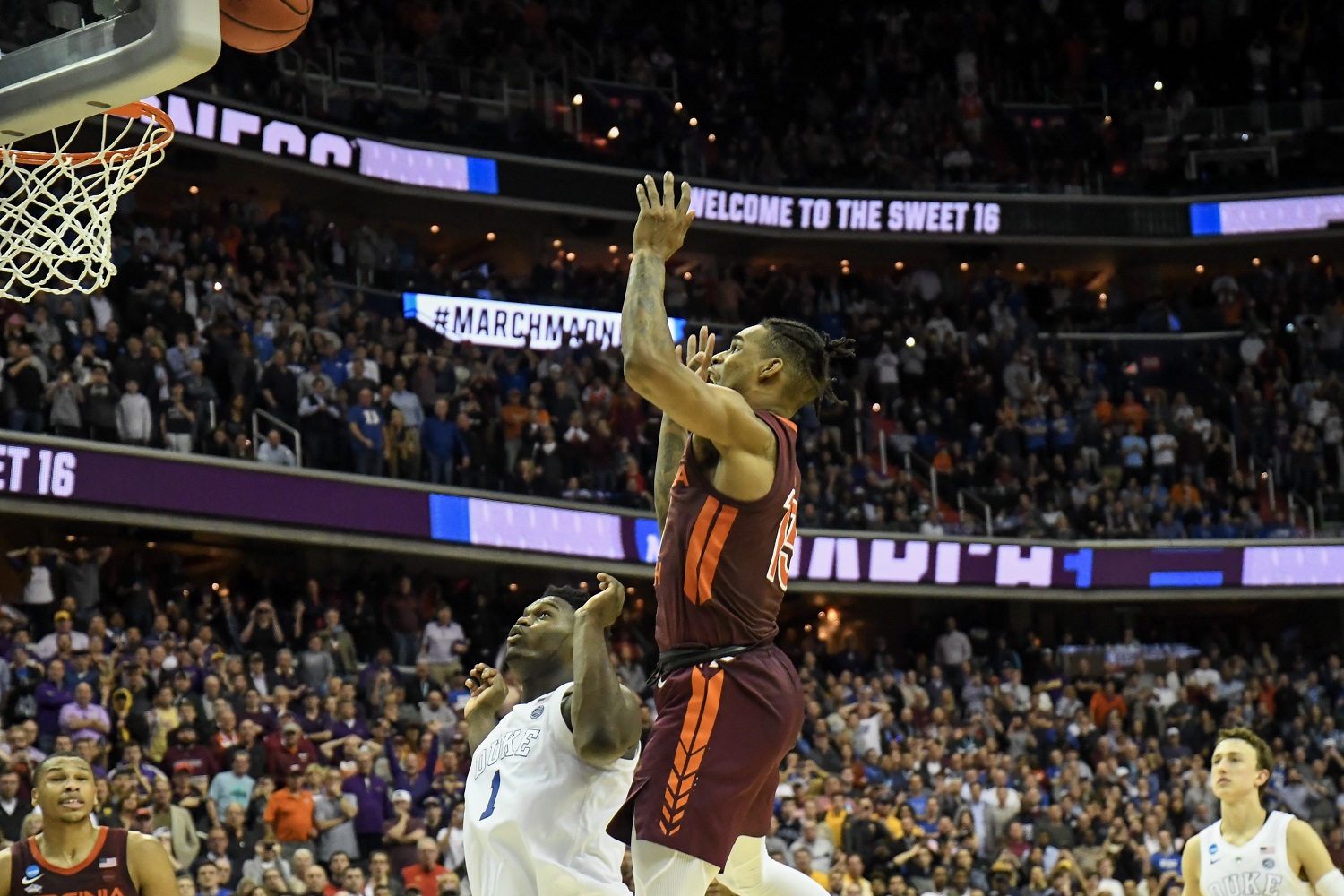
Ahmed Hill missed a point-blank shot off a Justin Robinson alley-oop as time expired, and Duke escaped with a 75-73 win over Virginia Tech in the Sweet 16 at Capital One Arena in Washington, DC. No. 1 seed Duke advances to the Elite Eight, while no. 4 seed Virginia Tech’s season ends at 26-9, the most wins in program history.
Hill’s game-ending miss was the third shot the Hokies missed in the last ten seconds. After Duke’s Tre Jones missed the front end of a one and one with 29 seconds left, Virginia Tech got the rebound, and Hill missed a three-pointer with ten seconds to go. Kerry Blackshear corralled the rebound, and Virginia Tech called a timeout with 5.8 seconds to go. The Hokies ran a play for Ty Outlaw, who missed a three-pointer, and Duke knocked the ball out of bounds with 0.6 seconds left on the clock.
The officials reviewed the play and set the clock to 1.1 seconds. Robinson inbounded from the right of the basket and threw a lob to Hill, who was cutting across in front of the basket and had an open look at the rim. Hill short-armed the shot and put it to the left side of the rim, where it fell harmlessly into the arms of Duke’s Zion Williamson as the clock expired.
The tough ending for Virginia Tech closed out one of the most entertaining games of the Sweet 16. The game featured nine ties and nine lead changes, with seven of the lead changes coming in the second half. Virginia Tech was not intimidated by the opponent or the magnitude of the game, hitting five of their first six shots to take a 15-9 lead. The Hokies led for 15:58 of the first half and trailed only briefly, for 1:18 of the half. Virginia Tech was up 38-34 at half time after ending the half on a 14-6 run.
In that first half, the Hokies shot 45% and made seven three-pointers, while Duke shot 52% and hit 4-of-11 three-pointers. Hill had 13 points in the half, and Virginia Tech got a surprise contribution from Wabissa Bede, who was Tech’s second-leading scorer in the half with ten points.
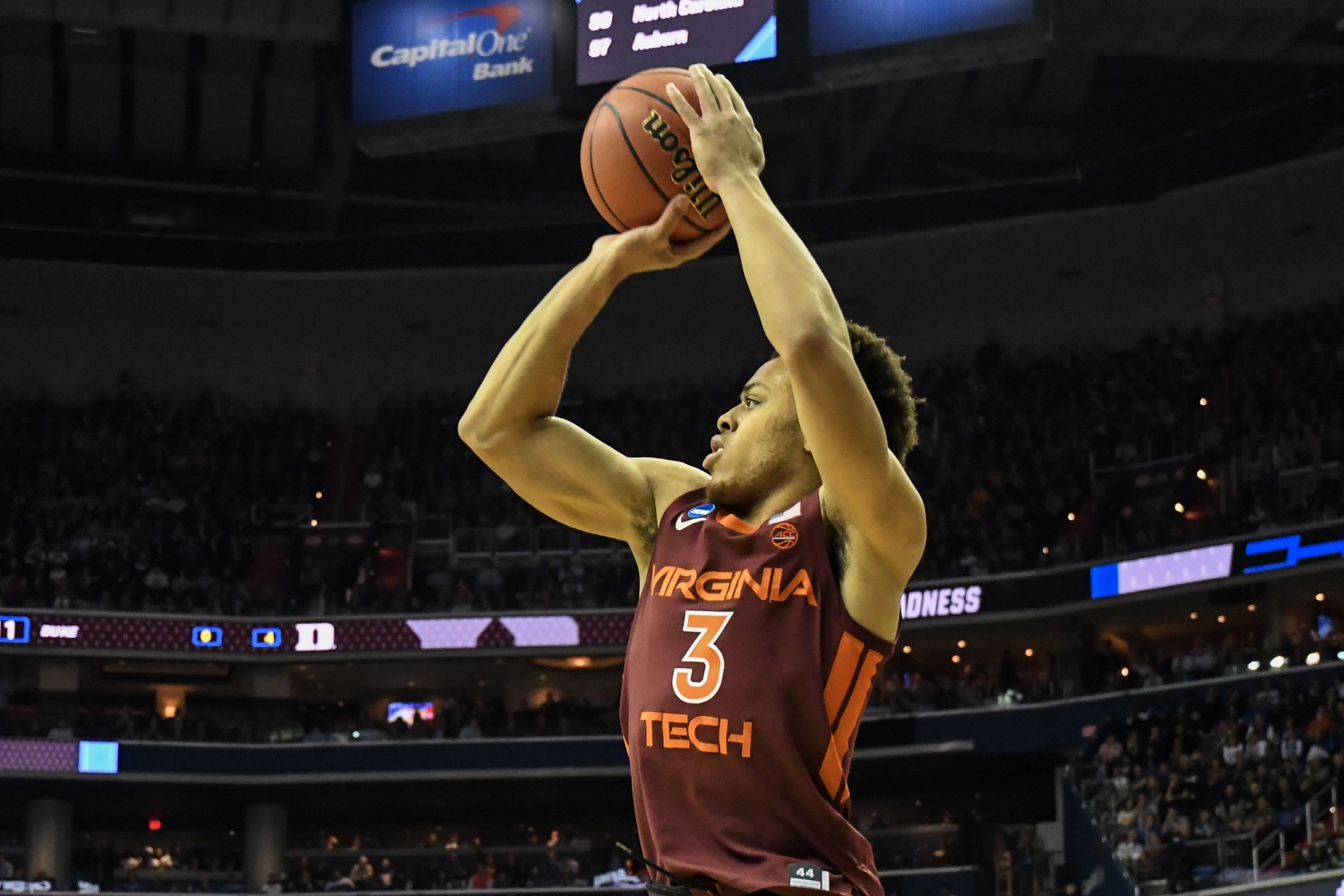
The second half was a different story. Duke blistered the nets for 17-of-29 shooting (59%) after the break, while the Hokies only made 12-of-33 shots (36%). Duke outscored Virginia Tech 26-14 over the first 11:15 of the second half, opening up a 60-52 lead with 8:45 remaining.
The Hokies gradually clawed their way back into it, closing Duke’s lead to 66-64 on a three-pointer by Nickeil Alexander-Walker with 5:11 to go. The two teams traded buckets to make it 68-66, and then Tre Jones hit a three-pointer with 3:51 left to put the Blue Devils up 71-66. Alexander-Walker missed a three-pointer about 30 seconds later, and a Zion Williamson dunk put Duke up 73-66 with 3:01 remaining.
Williamson’s dunk was Duke’s last field goal of the game, but the Hokies were unable to take advantage of Duke’s scoring drought from the field.
The Hokies were hurt by an uncharacteristically good three-point shooting performance by Tre Jones. Jones came into the game shooting 23.2% from behind the arc, but he made 5-of-7 in this game, as the Hokies sloughed off him in an attempt to clog the lane and slow down Zion Williamson. The rest of the Blue Devils shot just 1-of-13 from the outside, but Jones’s three-pointers were enough to help Duke overcome the absence of Cam Reddish, who sat out the game with a knee injury.
Williamson put on a show as usual, dunking three times and blocking three shots. He scored 23 points, right around his season average of 22.5, and like his teammates, he was efficient, making 11-of-14 shots overall. Williamson, Jones (22 points), and RJ Barrett (18) combined to score 63 of Duke’s 75 points and shoot 26-of-45 from the field.

The Hokies were led in scoring by Kerry Blackshear with 18 points, Hill with 15, and Robinson with 14. Virginia Tech’s top four scorers, including Bede with ten points, shot 19-of-41, but the rest of the team only went 6-of-21. Outlaw’s stat line was especially brutal: five points on 2-of-7 shooting, with zero rebounds and zero assists in 30 minutes. Alexander-Walker was 3-of-10 from the field (1-of-5 from three) with nine points.
Virginia Tech led one key metric, rebounding, 36-30. The Hokies had 17 offensive rebounds, the second highest total of the season (18 vs. Notre Dame), but Virginia Tech was only able to score nine second-chance points off those offensive rebounds. Duke by contrast had only eight offensive rebounds but also scored nine second-chance points.
Kerry Blackshear was a monster on the boards, grabbing a game-high 16 rebounds, more than all of his teammates combined (six of Virginia Tech's 36 rebounds were "team" rebounds).
One painful stat for Virginia Tech was points off turnovers, where the Hokies were outscored 17-9, despite both teams having 11 turnovers. Many of Virginia Tech’s turnovers were live-ball turnovers, and they led to Duke outscoring the Hokies 16-7 in fast break points.
It was the Hokies’ tenth straight loss to Duke on the road (seven straight) or at neutral sites (three straight). Virginia Tech hasn’t beaten Duke outside Cassell Coliseum since winning 69-67 in overtime in Durham on Jan. 6, 2007.
The upcoming offseason will be one of change for Virginia Tech. Robinson, Outlaw, and Hill are all seniors. Alexander-Walker is projected to be a first-round NBA pick, while Blackshear has one year of eligibility left but has already graduated and could decide to move on. Meanwhile, head coach Buzz Williams is heavily rumored to be heading to Texas A&M.
Nonetheless, the Hokies stood toe-to-toe with the Blue Devils and impressed a nation watching on television. Capital One Arena, where Virginia Tech fans appeared to outnumber Duke fans, was full and rocking throughout. The Sweet 16 appearance is Tech’s deepest run in the NCAA Tournament since making the final eight in 1967, in a field that only included 23 teams.
The three straight NCAA Tournament appearances by the Hokies prove that you can win at Virginia Tech. Interest in the program is at its highest level in almost a decade, and the challenge is to figure out how to keep the program momentum going.