Sponsored Content: Periodically, we will be bringing you updates on Virginia Tech's Drive for 25 Hokie Club campaign. This is the latest in a series of sponsored articles that will keep you up to date on the campaign.
It’s March 1, and for the Hokie Club, that means it’s a critical month in the Drive for 25 initiative.
Introduced in December 2016, the Drive for 25 has the stated goal of increasing Hokie Club membership to 25,000. When the program was announced, Hokie Club membership was only 10,609, making the end goal of 25,000 an ambitious long-term project.In the initial months of the program, Hokie Club membership increased to record levels. By April 2017, the Hokie Club was up to 13,170 members. But there was a significant driver behind that increase. For the first time ever, Virginia Tech tied football and basketball seating to per-seat minimum donations to the Hokie Scholarship Fund.

Sponsored by the Hokie Club's Drive for 25: The "Drive for 25" initiative seeks to increase membership in the Hokie Club to 25,000 members in order to provide student-athletes with scholarships for a Virginia Tech education, as well as the resources necessary to compete athletically at the highest levels. Click here to join us today!
Starting with the 2017 football season, to sit in most areas of Lane Stadium and Cassell Coliseum, you now had to donate money to the Hokie Club, specifically the Hokie Scholarship Fund. The amounts required in Lane Stadium, for example, ranged from $800 per seat for the best seats, to $50 per seat for locations farther away from the action, with only a few seats requiring no donation at all. The same structure applied for Cassell Coliseum.
The goal was to increase giving to the Hokie Scholarship Fund — funds specifically earmarked towards paying for athletic scholarships. Virginia Tech’s athletic scholarship bill was quickly approaching $15 million per year when the program was announced, and the Hokie Club was seeking to take in funds that would specifically pay the scholarship bill.
In March 2017, season ticket orders and donations for the 2017 football season were due, and in that month alone, Hokie Club membership increased from about 11,000 members to the 13,170 stated above.
That completed a four-month stretch from the announcement of the Drive for 25 program to the first round of season ticket renewals that provided the biggest boost to Hokie Club membership that we’ll probably ever see. The Hokie Club benefitted from the PR surrounding the new program and the introduction of the per-seat minimums.
Now the hard work really kicks in.
Why This March is So Important to the Drive for 25
One year later, as we enter March 2018, Hokie Club membership stands at 12,664, per the Drive for 25 tracker. That number is updated as of Feb. 28, 2018.

While it sounds as if Hokie Club membership has declined from the 13,609 above, that’s not exactly accurate. The Hokie Club fiscal years run from July 1 to June 30, and when the Hokie Club enters a new fiscal year, as it did on July 1, 2017, the membership number resets to some extent, as some memberships “expire” and the Hokie Club waits on renewals for the fiscal year.
It’s more meaningful to compare year-over-year numbers on the same dates. On March 1, 2017, the Hokie Club had 11,089 members. On March 1, 2018, the Hokie Club has 12,664. That’s a difference of plus-1,575.
While that’s encouraging, the question is, will Hokie Club membership see the same increase this March that it did in March 2017? When we check the numbers on April 1, will they still be 1,500 or so ahead of last year’s numbers?
Last year, the Hokie Scholarship Fund per-seat minimums were new, and that created a one-time increase in Hokie Club membership that may or may not be replicated this year. This is uncharted territory, much like last year’s introduction of the program was.
The two critical dates that lie ahead are March 16, which is the deadline to renew or purchase season tickets. As we approach that date, Hokie Club members will make the decision to stay on board or not, and other fans who are not in the Hokie Club will make the decision to get on board and purchase season tickets, or not.
The other critical date is March 31. That’s the deadline for those who are committed for the 2018 football season to make their Hokie Club donations to support their season ticket purchase.
Once those two dates are cleared, we’ll be able to compare April 2018 numbers to April 2017 numbers, and we’ll have a better picture of the progress the Hokie Club is making towards their stated goal of 25,000 members.
One encouraging note — the 2018 home football schedule is one of Virginia Tech’s best in years, with seven home games, including resurgent Miami, Virginia, and Notre Dame’s first-ever trip to Lane Stadium. Georgia Tech will visit on a Thursday night, and William & Mary replaces Delaware as this year’s FCS home opponent. An in-state FCS team is always a superior draw to an out-of-state FCS team.
The full home schedule:
- Sept. 8: William & Mary
- Sept. 15: East Carolina
- Oct. 6: Notre Dame
- Thu, Oct. 25: Georgia Tech
- Nov. 3: Boston College
- Nov. 17: Miami
- Fri, Nov. 23: Virginia
That’s a great home schedule, one that will help season ticket sales and thus Hokie Scholarship Fund donations.
A Couple Additional Notes on the Drive for 25
In my various discussions with Hokie Club officials, some off the record and some on, their focus is on the dollars raised for scholarships, more than on the number of Hokie Club donors. Publicly, “Drive for 25” is everywhere, but I get the sense that internally, the “drive” is to stay ahead of the increasing cost of scholarships and to make sure the Hokie Scholarship Fund is covering what it’s supposed to cover — athletic scholarships.
When the Drive for 25 program was announced in December 2016, Virginia Tech director of athletics Whit Babcock said, “It is specifically for scholarships … it will not be used for coaches’ salaries, or AD salaries, no frivolous spending … it simply provides our foundation and the cornerstone of all we do.”
Clearly, increasing the number of donors and staying ahead of ever-rising scholarship costs are two goals that go hand in hand.
I also get the impression that the membership goal for this year is about 15,000 members when the Hokie Club ends its fiscal year on June 30, 2018. Last year, the June 30 number was 13,635. With today’s March 1 number standing at 1,575 more than last March 1, you can see that 15,000 by June 30 is in range.
The bottom line is, if April 1 rolls around and Hokie Club membership is over 14,000, perhaps as high as 14,500 or more, the Drive for 25 will be chugging along. It’s a marathon, not a sprint, but a membership number of about 15,000 by June 30 would represent a big increase over the 10,609 from just a year and a half ago.
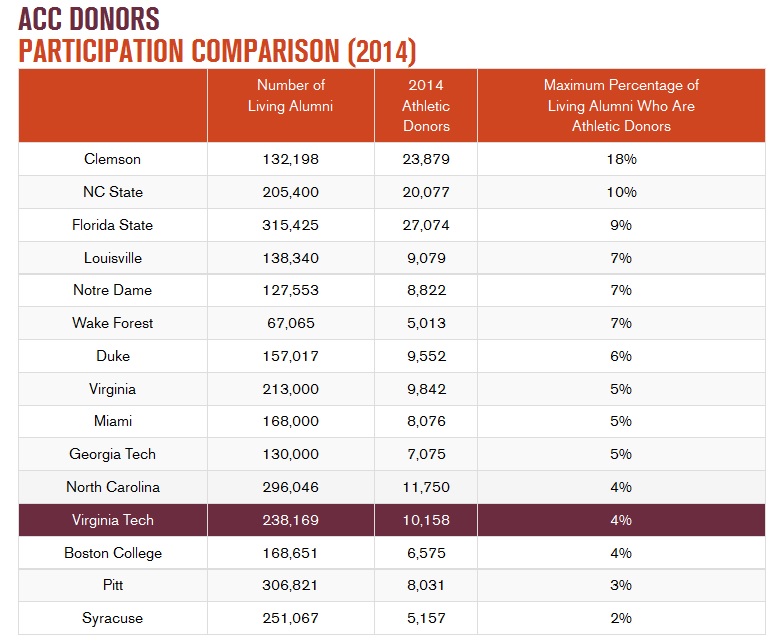
We’ll end this update with a couple of graphics to remind you of what the ACC competition is doing. These graphics are from 2014, but they still put things in perspective. They also show you the progress Virginia Tech is making compared to their ACC competition since the Drive for 25 was introduced. Surely the competition hasn’t been standing still since 2014, but at least Virginia Tech’s numbers are more respectable now than they were four years ago.